Lopsided eyes and mild panic: A cautionary tale.

Life changes and I’m back to a routine of walking to work every morning. I’m loving the extra little workout every day! I also walk home three days a week. The big change in the equation is that on the other two days, I take the bus home so I can get there fast, change my clothes, and drive to Mesa for Body Combat. Why? Callaghan now works on-site full-time, and the site happens to be in BFE (very far away, in case you didn’t know the acronym). This necessitates me taking myself to the gym. Which is fine. As long as I can get there!

(The adjustment to Callaghan’s new schedule and location has been a learn-as-we-go process in many ways. Our lives are very different now. And on Monday, I did NOT make it to the gym, because I literally had no way to get there. That was the last time that was going to happen!)

On Wednesday, I got to the bus stop early and wondered what to do with the spare 15 minutes. People-watching opportunities were oddly nonexistent at University and Mill. What else is there to do while waiting? Take a selfie. Or twenty.

I don’t take selfies very often. It doesn’t occur to me because I’m always looking for interesting, stationary subjects to photograph, or I’m stalking my cats with the camera. There was nothing of interest from my vantage point at the bus stop, and my cats were selfishly sitting at home, so I thought it would be amusing to capture a rare moment of myself being bored in an unusual place.

All that happened in the end was I freaked myself out, though. A little bit. Just a little.

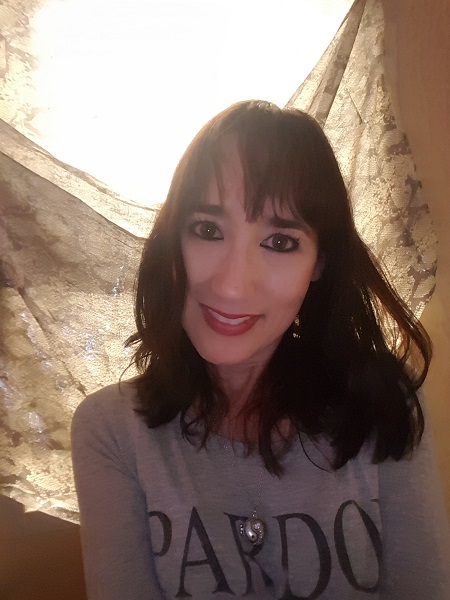
The selfies I took showed my eyes looking lopsided. They were mismatched. One eye looked larger and different than the other. This alarmed me because I thought I remembered reading somewhere that psychopaths often have in common a noticeable difference between their eyes. While no one’s features are perfectly symmetrical, the eyes of a mentally unstable person can be very obviously unlike each other. (I know I read this somewhere, but now I can’t find anything about it, of course.)

Thing is, I do live with mental illness in the form of clinical depression and PTSD, but I never thought I looked mentally ill. The selfies suddenly made me feel paranoid. Then I became paranoid about being paranoid, and that made me feel crazier. I wondered if my mental health situation was really what I thought it was, only. And very quickly, the whole thought process took off on a continuous, self-perpetuating loop inside my brain.

To stop the merciless cycle, I deleted all of the selfies.

I went about the rest of the evening not thinking about it. I went home, went to the gym, and went out to dinner with Callaghan, and I didn’t think about it at all.

Later that night, I went to remove my make-up and saw that my eyeliner was thicker under one eye than the other, and the two lines didn’t match in shape. All along, it was my eyeliner that didn’t match! That would do it. Eyeliner can change your face dramatically. Of course the eye with more liner would look larger, and the two eyes would look different with different liner shapes!

I looked like that before I went and sweated at the gym, so I’d gone around at work with lopsided eyes. How fun.

Either I was in too much of a hurry when I was getting ready that morning, or the eyeliner wore off unevenly during the day. The result was the same, though: I looked like a Picasso painting at work, and I almost drove myself crazy wondering if I was crazier than I actually am.

Yesterday morning, I took extra care with my eyeliner. In the afternoon, I took a selfie in my office:


(February 18, 2016)

(February 18, 2016)


I came out looking more normal, though the left eye still had slightly more liner than the right. Probably only I would notice it, now that I’m hyper-aware of the thickness and shape of my eyeliner. I may have to just set the camera down and back slowly away. It’s hard to get the two eyes to look exactly the same, and I only allow myself 15 minutes to do my make-up before going to work. It is what it is.

The lighting was surprisingly flattering, too, though. Also, it was a rare day that I put on e.l.f. primer under my foundation. I think I like it, after all.

And Callaghan loves his new job!

The Darkest Hour, Part 2

I’ve been wanting to continue on the theme of my Darkest Hour post, and I have to confess that I didn’t give it as much thought as I would have liked – but even as I finish writing this, sitting here on my lunch hour at work, I realize that it’s useless to try to compact the mysteries of nebulous life problems away into neat little lines of text. So this is just me, not being a psychologist or a counselor of any kind – there’s my disclaimer! – rambling a little about life and crises and regret and goals and action.

Mainly what I want to say is, things aren’t always as bad as they seem.

You know how when you stare at something really hard, your vision blurs until the thing becomes obscured? Or how, after searching frantically for something, you give up, only to later realize that it was sitting out in plain sight all along… it was right there, but you couldn’t find it? The answers to the biggest questions in life are often like that, I think. They’re maddeningly invisible in their obviousness.

In fact, it seems that quite often, issues arise the more we try to see, look for, search for or find things. When using variations on the sense of vision doesn’t help us to figure things out, it might be time to change strategy.

Furthermore, when searching for “what I want,” that (whatever it is) often turns out to be a mythical beast, and why waste time and energy chasing something that may not even exist? Our hearts’ desires are often illusory in the sense that sometimes, we think we know what we want, but when we get it, we realize that we want something different!

For me, the more worthwhile challenge is to open my mind to knowing what I want – more in a process of discovery, rather than a searching for. If I (at least) believe that I know what I want, I can take steps toward getting it. I can set goals and strive to make things happen. Motivated by the ambition to reach my goals, I’m exempt from the struggle to find the answer to ultimately meaningless questions like “what do I want to be when I grow up?” and the tedious preoccupation with “finding myself” that I’ve seen bog people down until they’re lost in the confusion they’ve made of their existences. I try not to overthink my life and myself.

And as much as I like to joke about it, I don’t think I actually believe in the concepts of “mid-life crisis” or “identity crisis” or “existential crisis.” There’s just crisis, and the practice of labeling it and applying definitions to it only gives us more tools of procrastination we don’t need.


thatasianlookingchick.com-merriam-webster-crisis


A difficult or dangerous situation that needs serious attention.

Of course we all experience crisis, but everything can’t be a crisis. Just because we’re dissatisfied doesn’t mean that we’re “in a crisis.” There are degrees of difficulty and danger, for sure, and it’s always good to be aware (stay alert to stay alive!), but funneling our energies into taking the situation apart from the inside out usually doesn’t lead to anything but mental and emotional fatigue and frustration. We end up building apathy into the self-defeating cycle we’ve created, and that’s where we get stuck.

It’s blissfully liberating to realize that we can use that same energy to fuel our own productivity… and on our own terms.

It’s worth endeavoring to become a creator and collector of goals, both long-term and short-term. It’s worth trying to become a dedicated collector and keep those goals in sight, lined up all nice and neat.

Success, victory and triumph are personal, even intimate degrees of measure we construct for ourselves. It’s not just the day you win at a competitive event wherein everyone can witness your badassery. It’s more meaningful the day you can say, “Hey! I’ve finally stopped making that one mistake.” It doesn’t matter if you had to make that mistake five or ten or a hundred times before that. The growth still happened. You developed as a person. YOU did that for yourself, and in doing that, you gained freedom from old restraints.

Regardless of where I am at any given moment, as long as I can look back at my own life and note progress happening somewhere, in some realm of my being and existence, I feel successful.

And what of regret? I want to address this briefly, too, because it’s another thing that can drag us down.

Regret doesn’t have to be a spirit-crushing specter overshadowing our lives. Aside from the inevitable random moments of thoughtlessness in which we speak or behave carelessly (if we’re human, there’s no avoiding these moments – all we can do is learn how to handle our blunders with grace), there are difficult times during which we’re likely operating in “survival” mode, meaning that our thinking is foggy, or we aren’t thinking, at all. We’re distracted and worn-down by an onslaught of challenges that causes us to see everything as a threat. We’re propelled to action, and sometimes, in the urgency of the situation, we misdirect that action, making decisions we might later wish we hadn’t. We can make bad judgment calls regardless of the goodness of our intent. It just happens sometimes.

But it’s easy – too easy – to look back on these moments years later and feel regret, guilt or shame when we’re no longer under duress. Berating ourselves from that detached standpoint isn’t fair to our past or current selves. We can wallow in regret, or we can grow from our experiences by taking away lessons offered through them.

Regret is something we can manage by recognizing any mistakes that may have caused it and accepting that we made them, with gracious allowance for the external factors that comprise “circumstances.” Then we can gather our hard-won nuggets of wisdom and relish the satisfaction of a more mindful moving-forward. We can proceed with a purposeful energy infused with something akin to defiance and rebelliousness, that revitalizing energy that allows you to be the surfer standing on two feet at the crest of the wave not only with determination, but with joy, as well. We can commit acts of joyful courageousness on our quest to attain our goals. There’s a sense of liberation there, and the view is stunning. 

This brings me to the subject of balance, but I’ll save that for another day.

Addicted to Fear? (PTSD post.)

Q: What happens when you watch the American Horror Story: Freak Show premiere and the first two episodes of Stalker all on the same night?

A: The next time you’re alone in the house, ALL THE LITTLE NOISES will cause you to jump and imagine that the most terrifying clown you’ve ever seen is creeping around your windows.

And, if you’re kind of warped, like me, you’ll love it.

Twisty the Clown

Twisty the Clown

Fear is a mysterious emotion. It can be taught, or it can be intuitive. It can be provoked by things we perceive with our own senses, or by others’ senses. Fear as a response to external stimuli real or imagined can also be unpredictable.

Twisty the MURDER Clown, that is.

Twisty the MURDER Clown, that is.

I have phobias, meaning that I experience irrational fear in response to specific things. I also have PTSD, meaning that I have a few known “triggers” floating around in a deep lake of more inexplicable, unknown causes of panic. The resulting inner havoc is predictable even if its cause is not… it’s the familiar old Armageddon of panic and stress boiling in my core, rippling outward through my body like a fire spreading through a house. It feels like I’m being consumed. Sometimes, it even feels like I’m going to die, or like I have to die. I actually take medication for this. Throw in the by-product of clinical depression just to balance it out, and there you have the main reason I live for my body combat classes at the gym three days a week. I enjoy them because they’re amazing, yes, but I also need them for medical reasons. Intense physical training on a regular basis helps my brain chemistry better than anything.

So it’s a mystery to me why, when a former boyfriend introduced me to the creepy PlayStation game Silent Hill (the only video game I’d played since the ‘80’s), I quickly became addicted and couldn’t wait for darkness to fall every night so I could huddle in the shadowy corner of the bed with all the lights out, trembling and listening to the discreet yet horrifying sound of snow crunching beneath my feet (leave it to developers of Japanese horror to make the sound of snow horrifying) as I walked through the abandoned town in search of my daughter. You would think the eerie sense of being watched and the unpredictable sightings and attacks would have sent me into PTSD Armageddon, but instead, I found myself craving more.

It’s odd, this thing about the horror genre in pop culture. If scary movies, television shows, books or games manage to provoke fear or stir up the creep factor even a little bit, which very few of them can do, by the way – my favorites are the ones that can – I just twitch a little and then run back for more. Yet, the sight of a sewer roach encases me in fear and leaves me traumatized for days. Why is that?

I would venture to guess that the PTSD lurks behind this incongruity. Fear strikes, and in that moment of skyrocketing adrenaline, I’m instantaneously alert and on edge. Maybe, in some perverse way, I love it because it makes me feel alive… alert, alive and ready to act, and when this response comes in the wake of stimuli that I know is fictional, I can just enjoy the rush. There’s no real-world threat in fiction. (A roach is not a formidable threat, but it is real.) Maybe I’ve become a “fight or flight” response junkie, though I don’t think I’d go so far as to say I’m addicted to adrenaline, a phenomenon that some people apparently experience. For me, in the case of creepy movies and T.V. shows and books, maybe I’m more just hyper-intrigued by the fear of the unknown, and of the (horrifying) possibilities. Neither am I sure that there’s much of a difference between this kind of fear addiction and the kind of garden-variety thrill-seeking that leads people to go bungee-jumping (I am not a thrill-seeker of the bungee-jumping variety). Whatever the case, I find the psychology of fear to be fascinating. Fear is terror-provoking, thrilling, necessary and fun. What emotion other than love covers all of that?

My affection for the horror genre pre-dates my PTSD, so perhaps that’s significant, as well.

I also think that it’s my PTSD that drives me through whatever martial/fighting arts training I’m doing, especially when my energy stores are low, though I’d loved combat sports long before the PTSD, too. In high school, I was the girl who demanded that the P.E. faculty allow girls to take wrestling, because that was what I wanted to do, and I was outraged that only boys could take it. (In the end, they acquiesced, but only because I got other girls to sign my petition, indicating that they would take it with me. We were only allowed to wrestle under the stipulation that we’d wrestle each other, rather than the boys. Haha!) (I don’t think that anyone was surprised when I joined the Army after that.)

On the tail of that tangent, let’s all take a moment to acknowledge that Halloween is just two weeks away. I’m beside myself with glee. We’re in a house now, which means that we get to give candy out to trick-or-treaters. I wonder how many American Horror Story Twisty the Clowns we’ll find on our doorstep Halloween night? I can’t wait to find out!

Happy Friday, All!

The Darkest Hour

Right now, as I witness a number of my friends working through some pretty daunting life challenges with strength and courage, I’m inspired to muse on my default coping strategy. I prefer the word “strategy” to “mechanism” because it’s action-oriented, but the one I have in mind is actually more of a simple trick.

The idea is to navigate hardships with the cautious confidence of a surfer standing, feet planted on her surfboard, on the crest of the wave rather than flailing every which way in a murky turmoil, struggling in the lung-burning angst of one who gets pulled underwater and tossed around… right? Like everyone, I’ve spent a fair amount of time in the bewildering throes of the latter. I thought I’d relay the trick that pulls me up and out, since I’ve been thinking about it.

That is, I think about words and language a lot.

I’m talking about popular axioms in the forms of adages and idioms, proverbs and platitudes. Many of these are interchangeable, these banal sayings and feel-good, preachy expressions, and they’re clichés. They’re filler material in our lexicon, the expressions that writers are advised to avoid. If we want to write in those terms, we’re told, we can apply for jobs writing for greeting card companies or cranking out fortune cookie fortunes. We’ve developed such a knee-jerk reaction against these age-old “words of wisdom” that our eyes start to roll before we even finish hearing them, and we tend to feel insulted when someone throws one at us in the depths of our struggles. A saccharine platitude weighed down with didacticism all dressed up in a cheery tone of voice makes for a hell of a life raft, even if the people offering it have their hearts in the right place.

 

Definition: Adage (Merriam-Webster)


But I’m thinking maybe it’s different when you repeat those tired, trite expressions to yourself, because they have a way of getting me through when I’m the one using them to coach myself along. In keeping with the definition of “filler material,” the words are always right there, spilling out over the edges. The trick is to start paying attention to them, at which point you can turn them over in your head, repeatedly, performing a sort of mental twiddling of the thumbs. Then the expression takes on the function of background music, and somewhere in the repetitive space of this thinking about it without thinking about it, a sedative effect comes over you, numbing you so you can forge ahead. Dull pain is still pain, but it’s manageable, and you can work through it.

Maybe I’ve just described the power of a mantra, which would suggest that you don’t have to read tomes on Eastern philosophy, convert to Eastern religion or become a yogi to experience this effect. Ordinary Western sayings can work as mantras, too.
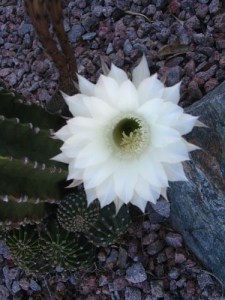
A perfect cactus bloom from my house in a past life.

A perfect cactus bloom from my house in a past life.


It began in elementary school when I read Laura Ingalls Wilder’s On the Banks of Plum Creek and came across the adage “the darkest hour is just before dawn” for the first time. Aside from finding this to be a metaphorically beautiful expression, it just resonates in a way that other, similar sayings don’t.

Now, when the cyclical rhythm of life gears down to “Low” and I find myself spiraling off into what I call The Great Abyss of WTF for a stay of indefinite duration, that old adage comes clanging back at me like a rabid cow with tricked-out bells… yet somehow, the accompanying sound is sonorous rather than cacophonous.

“The darkest hour is just before dawn.”

Many of these expressions of age-old wisdom often ring true. It’s maddening, but expressions get overused for a reason. “Things will get better.” Circumstances in life usually do get better, but not, for some reason, before they get worse. In fact, things often have a way of getting exponentially worse just when you’re thinking that they couldn’t possibly. Right after that, though, something happens… you reach a breaking point, and then you get a consolation prize! That’s the magic. The breaking point is where the magic happens. The breaking point creates a wellspring of potential. Disaster prompts action, action leads to change, and change leads to improvement. Or, change leads to sub-sets of challenges – small steps, baby steps – that will inevitably lead to better times. “The darkest hour is just before dawn” is a potent reminder. In retrospect, I can spot the breaking points in my life and see clearly that they were just turn-around points, flashing with the lessons I needed to learn.

“Hope for the best, but expect the worst” is also helpful. For me, this proverb provides encouragement to proceed with cautious optimism and requires just a bit of old-fashioned samurai stoicism.

“This, too, shall pass” comes to mind, but this expression is more of a reassurance than a warrior cry for perseverance. It’s useful when you want to will yourself through some sort of unpleasantness. It’s what you think when you’re sitting in the dental hygienist’s chair and she’s earnestly working away with that sinister, metal tartar-scraping hook thing pierced halfway into your gum-line and she hits a nerve – zing! – every other second, and you find yourself holding your breath while your fingers curl into fists until your nails dig into your palms and sweat pops out of the pores all over your body. Breathe. This, too, shall pass. (And then it does, and then you’re fine, until the next cleaning appointment rolls around six months later.)

It’s when situations in life get tough that I brace myself for the darkening and I actually hear those words in my head, repeatedly, mantra-like: “The darkest hour is just before dawn.”

It’s true that “things could always be worse,” but this adage doesn’t inspire or motivate me in any way. It’s merely an observation, and an annoying one, at that. “Things could always be worse” is the “You don’t have the right to feel that way because that’s a FIRST WORLD PROBLEM” adage.

Yet, perspective is a profound thing, and perspective is the take-away from “things could always be worse.”

For instance, when I came back from six months in Saudi Arabia, Iraq and Kuwait during the Gulf War, I didn’t have a bad hair day for literally years, because the concept of a bad hair day is inconceivable once you’ve lived in the desert with no semblance of civilization for six months and your main concern each day is whether you’re going to live to see the next. Good/bad hair doesn’t factor into survival mode. I was able to wash my hair every once in a while out there, but it was a tedious and dicey affair (you’re vulnerable when you wash your hair!) that required using rationed water. We had small bottles of Pert (Shampoo and Conditioner in One!) that were either issued or donated… I don’t remember which, but I remember that its fresh, green scent in my hair was an unspeakable luxury once the hair-washing production was over. (I haven’t used Pert since, but I would probably recognize its scent instantly.) That’s what clean hair amounted to: an intermittent, tense luxury. 23 years later, I now certainly do have bad hair days, but I haven’t forgotten. It’s the little things, and I don’t take them for granted.

“The darkest hour is just before dawn” is my favorite adage because it does inspire and motivate me. It turns out that a lot can be done in the dark. You can do some of your best creative thinking in the dark; sight deprivation amps up your remaining senses, and with that bolstering comes an almost supernatural ability to strategize your way out of your predicament. Perhaps this is partially why some of the most compelling poets and writers in history wrote from dark places, oftentimes chronically. It’s like The Great Abyss of WTF was a grungy old motel they checked into one night and never left. (Sadly, many brilliant poets and writers died in that darkness, dissolving into addiction or turning to suicide… but they left us with a body of written work that will inspire and captivate people until the end of time.)

Another thing I do when facing extreme difficulty is I veer in the opposite direction and convince myself that the worst-case scenario will happen, and I focus on that. I plan for it. This may sound counter-intuitive, and it goes against all the variations on the “Envision your perfect situation and it will happen!” theme popularized by the self-help genre of the last 20 years. (The Secret, anyone?) But somehow, focusing on the worst rather than on the best has been a tactic that’s been of enormous benefit to me. (Here, I’m tempted to segue into the topic of Buddhism, but I’ll save that for another post.)

To focus on the worst is to put yourself in survival mode, and there, you begin to craft an action plan, since there’s nothing else to do. Once you’re in survival mode, you’re forced to take steps, many of them drastic. The alternative is to perish. That phrasing might sound dramatic, but that’s how it feels… and besides, presenting yourself with a life or death proposition works. As you funnel your energy toward that darkest imaginable place in your future, you suddenly find a). solutions to problems in unexpected places, and/or b). that while you were busy preparing for the worst, things were actually getting better… and the amelioration of your circumstances came about while you weren’t looking directly at them.

This is not as passive an approach as it sounds. The human mind naturally searches for solutions in everything, I think, even if we’re not aware of it. We take pleasure in solving mysteries and riddles and identifying patterns and finding answers. With our vision muddled, we discover other ways to make sense of things. Such as it is that things evolve… and that evolution happens in the dark.

The darkest hour is just before dawn.
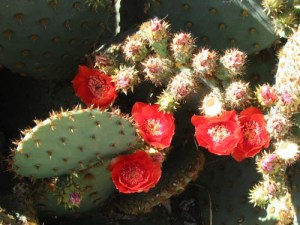
 

Spring in the desert is always the dawn!

Spring in the desert is always the dawn!


What I’ve come to realize is that the darkest hours are important. The darkest hours are hard, but they’re also the pivotal, life-altering and transformative times that are essential for growth and the wisdom we need to prepare ourselves for future hardships, because there will always be future hardships. No one is exempt from the vagaries of life.

A penultimate favorite quote: “In the end, everything will be okay. If it’s not okay, it’s not the end.”

Now those are fighting words! If it’s not okay, it’s not the end.

And finally, you know what they say: “When nothing goes right, go left.”

Which is about change. It’s all about change, and progress through change. It’s revitalizing. It allows me to be the surfer standing on two feet on the crest of the wave not only with determination, but with joy, as well. There’s a sense of liberation there, and the view is stunning.