Not sure whether any of you are the sort who’s interested in other peoples’ DNA test results, but I am. I find personal genetic make-up discovery stories to be interesting, and now that I’ve learned my own, I thought I’ve give back. I’ve been super stoked about my report since I received it last week!
I submitted my DNA to 23andMe for analysis. It’d been done in Palo Alto by researchers a year and a half ago, actually, but now I have the report. (Long story not worth telling, trust me.)
I’m excited to be demystified, especially as an adoptee. I’ve known that my bio-mother is Japanese-American, but all I ever knew of my bio-father’s genetics was “English.” Now I know the whole story: I’m English, German, Scandinavian, and Japanese.
For half-breeds, I guess, it’s rarely as simple as “my mother was this and my father was that, so I’m half this and half that.” I have to re-write that part of my bio now. Haha.
No makeup in paradise. And no, I will never stop rhapsodizing over our glorious Arizona winters. I took this selfie two days ago. [18 January 2021]
The report says that I’m 50.0% European and 49.9% East Asian, with a smidge more DNA from my European bio-father. So my bio-mother was right when we met and she observed that I take after my father’s family more than hers.
My European side is 39.2% British (from England: Greater Manchester, Greater London, and Merseyside), 5.8% German (from Hamburg), 4.2% Scandinavian (from they couldn’t say where), and 0.8% Broadly Northwestern European.
My East Asian side is Japanese (from Hiroshima Prefecture).
I wasn’t expecting to encounter such precision in my DNA report. I mean, I spit into a tube and someone in a lab is able to trace my recent ancestry to Manchester, London, Merseyside (they nailed it with that last one… my family is from Liverpool, which is in Merseyside), Hamburg, and Hiroshima.
Not a single strand of Welsh, Irish, or Scottish DNA was found, which was also a surprise. The internet says that my bio-surname is Welsh, but the lab coats with my saliva say that I have no Celtic DNA whatsoever. If there is Celtic DNA somewhere in my ancestry, I didn’t inherit it.
As for my 5.8% German heritage, I like to think that this explains why the German language came to me so easily and naturally when I lived in Germany. (Nothing like the struggle of conversing in French.)
One bit that came out of this DNA analysis experience was no surprise at all, because I’d been told as much by my bio-mother: if I want to meet my paternal family, I’ll have to leave the country. This was confirmed by one of my first cousins (23andMe connection)!
Almost all of my bio-father’s huge family lives in England, including him, which I already knew. A fraction of the family lives in Canada, mostly in Greater Toronto… whereas I have no extended family members living in Japan. My maternal family is here in the States, and they’ve been here for generations.
My Asian side is American. My European side is not. HA!
(Is it still accurate to say that my British family is European now that Brexit happened?)
My bio-father has many siblings, so I have many aunts and uncles, and loads of cousins. 14 first cousins! I’ve been getting to know a couple of them, and I’m beyond touched to know that they’re as thrilled by our newfound connection as I am… and to know that they’d been wondering if they’d ever find me! I had no idea that anyone in the family even knew that I existed.
I can’t get over it. I’m so pleased and grateful, and the fact that my amazing parents are 100% supportive – and also curious – makes it even better.
23andMe’s analysis also revealed such trivia as: I inherited my preference for salty over sweet; my ring fingers being longer than my index fingers; my ability to match a musical pitch; my flat feet; my fear of heights; and the fact that I’m a mosquito magnet.
My parents had wanted to see Hacksaw Ridge, but they weren’t able to catch it in the theater… so we all watched it together in our living room when they came to visit a couple of weeks ago. Callaghan and I were eager to see it again, and we liked it even more on second viewing. Mom and Dad also enjoyed the movie.
Hacksaw Ridge is a World War II film, and it’s an important one for an unusual reason: it tells the true story of a young American man who joins the army as a conscientious objector, refusing to touch a weapon, but determined to make it to the front line as a combat medic. He was eventually allowed to complete basic training without rifle qualification. After finishing skill training, he was sent to Japan with an infantry regiment. There, the regiment fought the Japanese in the Battle of Okinawa atop the treacherous Hacksaw Ridge.
Hacksaw Ridge tells the extraordinary story of an extraordinary man whose extraordinary valor saved many lives.
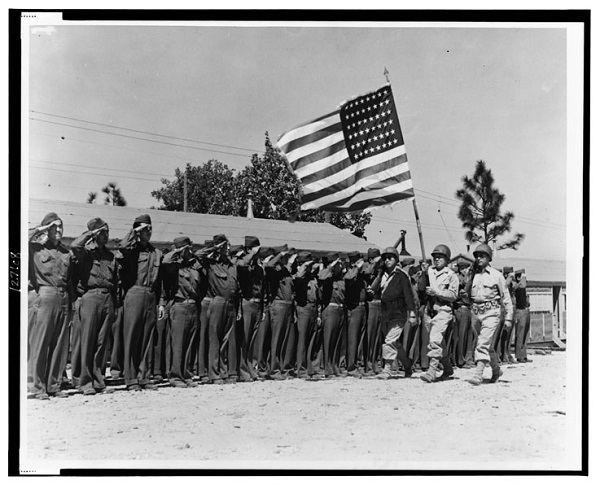
As I watched the scenes of Americans fighting the Japanese, it brought to my mind, as a Japanese-American, another WWII story: that of the United States Army’s 442nd Regimental Combat Team of the 100th Infantry Battalion. This infantry regiment was also extraordinary, and also for an unusual reason: the unit was comprised mostly of Nisei, second-generation Japanese-Americans, mostly from Hawaii.
I say “as a Japanese-American” because I’m not sure how many Americans in the general population are aware that there was a United States Army infantry regiment of Japanese-Americans fighting during WWII. As a Japanese-American, I’m aware of it, as it’s a part of our history in this country.
And it’s an important part of our history… not just in Japanese-American history, but in United States history, and in Hawaii’s history: the WWII Japanese-American soldiers of the 442nd went on to become a key factor in Hawaii gaining statehood. As intoned by narrator Gerald McRaney in The History Channel presents Most Decorated: The Nisei Soldiers, “On August 21, 1959, largely because of the Nisei soldiers, Hawaii became the 50th state.”
*****
American Desmond Doss (subject of Hacksaw Ridge) wanted to serve his country in wartime, but almost wasn’t permitted to do so because of his refusal to touch a firearm. Second-generation Japanese-American men also wanted to serve their country during the same wartime, but almost weren’t permitted to do so because of their Japanese ancestry.
It was a time when Japanese-Americans on the mainland were forced into incarceration… because of their ethnicity.
*****
The only ethnic Americans are Native Americans.
To say that we’re “American” is to describe our nationality – who we are as a nation. Americans are Irish-American, for instance… or African-American, or Japanese-American, or German- or Italian-American. Americans are Polish-American, Franco-American, Korean-American. Americans are Arab-American. And because of the ethnic diversity that characterizes our country, we’re a nation with a proud “mutt” population: many of us are of mixed ethnicity.
Our ancestry does not define who we are nationality-wise.
But during WWII, Japan was our enemy, and Japanese-Americans had the misfortune of looking like the enemy. On February 19, 1942, President Franklin D. Roosevelt signed an executive order that led to the incarceration of west coast Japanese-Americans, tens of thousands of Japanese-Americans removed from their homes and placed in the internment camps. Houses and businesses were confiscated. Families were broken apart. Living conditions in the camps were poor to horrendous; many internees were forced to live in horse stables, and all of them behind barbed wire fences patrolled by armed guards.
Not a single Japanese-American was ever found to be guilty of espionage.
Now, today, there are some amongst us who would like to repeat this shameful part of American history. They would like to round up innocent Arab-Americans and imprison them, just as Japanese-Americans were imprisoned during WWII.
*****
My parents are from Japanese-American families in Hawaii, some of which moved to the mainland to settle in California. While parts of these earlier branches of my family in California were incarcerated in the internment camps, two* of my uncles from Hawaii volunteered to fight in the United States Army as members of the 442nd Regimental Combat Team of the 100th Infantry Battalion.
When one of those uncles passed away in 2006, a retired veteran found his obituary, read that he was a WWII veteran of the 442nd, and contacted his son, my cousin. The gentleman told my cousin he would ensure that his Dad was recognized with the appropriate ceremony: a military funeral service. And so my Uncle’s casket was draped with the American flag and carried to his gravesite in the presence of an honor guard, and a bugle playing “Taps.”
*****
In 2011, Japanese-American WWII veterans – more than 19,000 of them – were awarded the Congressional Medal of Honor in a mass ceremony.
“The 442nd became the most decorated unit of its size in U.S. military history. In less than two years of combat, the unit earned more than 18,000 awards, including 9,486 Purple Hearts, 4,000 Bronze Stars and 21 Medals of Honor. Upon their return to the United States, they were praised by President Harry Truman for their brave stand both home and abroad, and were even the subject of a 1951 film, “Go for Broke”; the film’s title was derived from the unit’s official slogan. Many members of the 442nd went on to distinguished careers in science, academia and government, including nine-term U.S. Senator Daniel Inouye from Hawaii, who lost an arm due to World War II combat injuries and was among those attending Wednesday’s event.”
*****
Many Japanese-Americans were already serving in the armed forces when Pearl Harbor was attacked on December 7, 1941. When the attack occurred, Japanese-Americans were as horrified as any other American, and in Hawaii, especially, Japanese-American men wanted to join the armed forces to fight for their country.
To this day, Japanese-Americans serve in the United States Armed Forces. I’m proud to have been one of them.
My Dad directed me to the above-mentioned documentary from the History Channel. If you’re interested, watching it will be worth your while:
The History Channel presents Most Decorated: The Nisei Soldiers
Japanese-Americans’ wartime service didn’t begin and end with the 442nd: in addition to the 442nd, thousands of Japanese-Americans also had roles in the army’s Military Intelligence Service (MIS) during WWII. These Japanese-Americans “provided translation and interrogation assistance to the war effort. The MIS is perhaps best known for the crucial role it played in deciphering a captured set of Japanese military documents, known as the ‘Z Plan,’ which outlined plans for a final, large-scale counterattack on Allied forces in 1944. The discovery of the Z Plan has been hailed as one of the most important military intelligence successes of World War II.”
Valor comes in unexpected forms. It comes in the form of a young man who wants to serve unarmed on the front line of a bloody battle. It comes in the form of men who want to serve despite looking like the enemy, thus feared, maligned, and betrayed by their own country as Japanese-Americans were incarcerated because of their ethnicity.
The 442nd Regimental Combat Team of the 100th Infantry Battalion in WWII was the face of Japanese-Americans’ loyalty to their country. It was a loyalty they proved in bloody campaign after bloody campaign, national pride a stronger force than the racism that tried to oppress them.
*[Editing to add: since posting this piece, my family has remembered at least two more uncles who joined the 442nd. Two of them were incarcerated in internment camps in California when they volunteered.]


 That Asian-Looking Chick