
I realized something this week: all this time I’ve been writing about Mixed Martial Arts (MMA) in this blog, I’d assumed that everyone reading had knowledge of it.
I apologize. That was a silly assumption.
MMA is a sport relatively new in sports broadcasting, but it’s been growing in mainstream popularity, capturing fans beyond MMA participants and aficionados. This week, it was brought further out of obscurity when the term “Mixed Martial Arts” was dropped in a pejorative way before a broad audience.
It’s an awkward moment when someone who’s lamenting prejudice uses a specific example in a context that amounts to prejudice…
and when the speaker’s prejudice goes on display for the world to see, but much of that world doesn’t know any more about (MMA) than the speaker, so they aren’t capable of recognizing the hypocrisy of the comment.
On the bright side, MMA now has everyone’s attention, which offers a learning opportunity for those who wish to open their minds.
First, to be clear with my own terminology:
Definition of prejudice (Merriam-Webster)
- a (1) : preconceived judgment or opinion (2) : an adverse opinion or leaning formed without just grounds or before sufficient knowledge
- b : an instance of such judgment or opinion
- c : an irrational attitude of hostility directed against an individual, a group, a race, or their supposed characteristics
The gist of the prejudice against Mixed Martial Arts, its participants, and its fans captures this sentiment: MMA is a barbaric/low-life sport that gratifies the plebeian tastes of bros, bullies, rednecks, and mouth-breathing, knuckle-dragging Neanderthals.
Some general points I’d like to make:
1). History: Mixed Martial Arts (MMA) finds its roots in the sport of Pankration in the ancient Greek Olympic Games.
From Wikipedia: Pankration (/pæn.ˈkreɪti.ɒn/ or /pæŋˈkreɪʃən/) (Greek: παγκράτιον) was a sporting event introduced into the Greek Olympic Games in 648 BC and was an empty-hand submission sport with scarcely any rules. The athletes used techniques from boxing and wrestling but also other types, such as kicking and holds, locks and chokes on the ground. The only things not acceptable were biting and gouging out the opponent’s eyes.[1] The term comes from the Greek παγκράτιον [paŋkrátion], literally meaning “all of power” from πᾶν (pan-) “all” and κράτος (kratos) “strength, might, power”.[2]
–This is a broad summation of MMA, though unlike Pankration, there are plenty of rules in MMA.
Admire these images of Pankration found on Greek pottery:
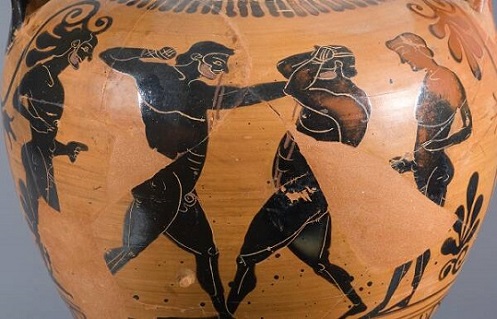
Pankration

Pankration
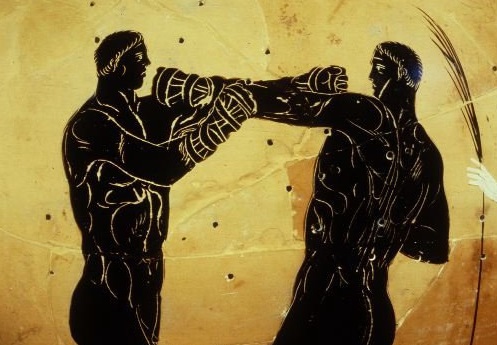
Pankration
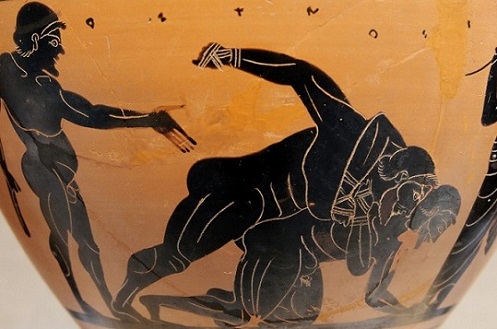
Pankration
2a).The original and most well-known MMA promoter in the U.S. is the Ultimate Fighting Championship (UFC).
2b). The UFC’s current champions include foreigners Amanda Nunes (Brazil), Johanna Jedrzejczyk (Poland), Conor McGregor (Ireland), Jose Aldo (Brazil), and Michael Bisping (England). The remaining five champions are American. Three of the American MMA champions are black.
Ergo, of the UFC’s 10 current champions, only two of them are white Americans.
3). MMA is an international sport rich with diversity. There’s no indication that racism is an issue in MMA such that it’s likely we’ll see a hashtag for FightCardSoWhite (as the hashtag OscarsSoWhite ripped through social media leading up to last year’s Oscars when well-deserving actors of color were snubbed in the award nominations, prompting some Hollywood stars and insiders to boycott their own union’s biggest award event.
(Hollywood is still working on living up to its own hype of being a paradigm of diversity and inclusiveness. But it will catch up to MMA soon enough.)
5). Mixed martial artists employ a variety of martial arts styles from various countries. Some of the arts comprising an MMA fighter’s repertoire are Muay Thai (Thailand), Brazilian Ju-Jitsu (Brazil/United States), Judo (Japan), Wrestling, Tae Kwan Do (Korea), Karate (Japan and China), and boxing. As the sport is evolving, we’re starting to see increasingly common usage of techniques from other martial arts, as well, such as Capoeira (Brazil), Kung Fu (China), Wu-Shu (China), and Kali (Philippines).
6). MMA is the only sport that has the word “arts” in it, and the term is there for a reason.
Classical martial arts involve body movement and training, discipline, and practice of techniques through choreographed sequences. In Karate, these choreographed sequences are called kata. They’re performed at tournaments as dancers perform in dance productions. The Shaolin Monks (China), for instance, perform their Shaolin Kung Fu techniques on prestigious stages all over the world. The art side of martial arts is akin to the art of dance.
Like dancers, martial artists spend countless hours practicing their techniques in order to master them. Command of their art demands mental as well as physical training.
In this video of a kata competition performance, the competitors display the artistry of Karate techniques, some of which are used by MMA fighters (punches, kicks, take-downs, ground-and-pound):
[Performance of Team Serbia in the WKF World Championships Belgrade 2010.]
5). The gender aspect: women joined the UFC’s ranks only 18 years into the organization’s inception. Before 2011, there were no women’s divisions in the UFC. (European female MMA fighters were competing in Europe before females could fight in the United States’ UFC.)
Ronda Rousey was the first female champion in the UFC. She not only paved the way for women in the UFC, but she arguably elevated the UFC and the entire sport of MMA to the status of household familiarity.
Since Ronda Rousey has been the most famous of the UFC champions, it’s a common mistake to judge her and then build on that judgment to make assumptions about the entire sport. Like her or not, Ronda is someone to respect for the success she’s achieved not only for herself, but for all of us. Ronda is a tough, ambitious woman who has overcome tremendous hardship in her life; she is inspirational in many ways.
Sidenote: Ronda got her very own Twitter insult from Donald Trump the year before the 2016 presidential election because she publicly declared that she would not vote for him. Ronda was an outspoken Bernie Sanders supporter from the beginning, so when she lost to Holly Holm, Trump was quick to tweet:
“Glad to see that @RondaRousey lost her championship fight last night. Was soundly beaten – not a nice person!”
The next women’s UFC bout I’m anticipating is Valentina Shevchenko vs. Julianna Pena on January 28. Shevchenko is from Kyrgyzstan and fights out of Peru. Pena is Venezuelan-American and fights out of Spokane, Washington, USA. This fight is the main event of the fight card – that means it’s the headliner fight – and the fighters are female. It’s not uncommon for female fights to headline a UFC fight card. How’s that for diversity in an organization that started out exclusively for men only 24 years ago?
I’m glad that MMA was brought into the spotlight via a controversial speech this week. Fall-out speaks volumes, and there’s always something to learn from it.

 That Asian-Looking Chick