A year later… (looking back)

Friday was the anniversary of my Major Life Change… it was a year from the day I quit my job and made a commitment to take on this writing project. I made the change on the cusp of spring (Happy Spring!), and the timing couldn’t have been more auspicious. Who doesn’t love fresh, shiny, new beginnings?

Of course we had to celebrate.

We kept it low-key, because that’s how we roll. We went for a lunch date on Friday at our favorite place near Callaghan’s work, and then for a movie date over the weekend. It was a good excuse to see John Wick 2, which I’d been wanting to see.

But I digress! Where am I a year later? I’ve been checking in with updates here and there over the last 12 months, but to recap:

Physically speaking, I’ve taken over the Room Formerly Known As Our Dining Room when the Room Formerly Known As My Office became Cita’s Room.

(“Physically speaking” is hugely important to me. I could take my laptop around the house and write, and I’ve done that and still do that, but I’m a person who needs to be grounded somewhere.)

This began innocuously enough, with just my electronics appearing on the dining room table. Things snowballed from there. I’ve even decorated the area according to my project’s theme. Writing is an art, a craft, a discipline, so if the environment needs to comply, one needs to pay attention, right?


After a year of writing, and everything that goes with it….


Some of my comfort zones have been left behind, too. Instead of having a fixed work schedule, I wake up to a unique day every day, and that’s a good thing, because it allows for fluid productivity, and fluidity is unforced. My creative energy has free reign.

I’ve recognized that for me, this kind of writing is a 24/7 job, and I’ve come to embrace that. It’s an ongoing exercise in recognizing my best hours for concentrated writing. The discipline lies in treating those times as sacred.

There’s continual reading and investigating and learning, a part of the process as a whole. For a year I’ve been eyeballs-deep in crash course after crash course on a hundred different subjects. My brain is swollen with information and (like all writers) I hope my search engine history goes unnoticed, but I haven’t felt more mentally stimulated since grad school over 15 years ago.

(The downside to this is that I’m in my head more, which doesn’t always translate to seamless social interaction. I’m flightier than ever, for one thing.)

The only concrete temporal structure I have in my week is my blog posting schedule and my gym class schedule, and that structure is non-negotiable, especially the gym part. If I don’t make it to the gym, it’s for medical or transportation reasons, or the occasional scheduling conflict.

This work has been challenging and tough from the standpoint of mental well-being, too, but it’s been positive, overall. I owe Callaghan a debt of gratitude for nudging me onto this path in the first place, and for being my number one support system and a faithful reader of the material. Also, thank you all so much for reading here and for accompanying me on this journey!

I went to a big-ass party and this is what happened. (PTSD post.)

We went to a party on Sunday. It was Callaghan’s company’s “holiday soiree.”


thatasianlookingchick-com-holidaysoiree2016


(I concealed the names of the company and the party’s hosts.)

If the colors on the invitation seem unusual for such an event, it’s because the party’s theme was “early Mardi Gras.” If you didn’t know, Mardi Gras colors are purple, green, and gold. I’m not sure why it was decided to celebrate the holidays as another holiday that takes place in February, but that’s irrelevant. Well… mostly irrelevant.

We donned the requested semi-formal “festive attire” (I wore a red dress because I was feeling the current season… I wasn’t alone in this), and we ordered an Uber.

The Uber took us to BFE (far away from us, in the middle of nowhere) with no discernible civilization around. We were dropped off in a big-ass parking lot. To enter a big-ass tent. Which led us into a big-ass warehouse. In which there was a big-ass party with roughly 800 people, pretty much in the dark, save for spot lighting here and there.

No part of which agreed with my big-ass case of PTSD.

Not only that, but when we walked into the warehouse, the first thing that happened was a few metallic strings suddenly dropped from the air, straight down, and landed with a clatter on the concrete floor, right in front of my feet. Because, you know, Mardi Gras. It was someone’s role to stand on a second-floor balcony and throw beads down in front of people walking in. This surprise INCOMING situation set me more on edge, though I didn’t show it. I smiled and laughed and talked to people, and I enjoyed the excellent band. I enjoyed meeting some of Callaghan’s co-workers and their wives. I did have a good time in some sense. I focused on that. We stayed for four hours, and I was fine.

Here’s the thing: Like everyone with PTSD, I have some known triggers, and I have some random triggers that can come out of nowhere. I went into the party thinking that my introversion would be the issue, but my panic disorder overrode that completely. It would’ve been great if being an introvert was my biggest challenge.

In response to all of this, I’ve decided to book myself an hour in a sensory deprivation tank.

Yes, you read that right. I’m going to strenuously push my limits in the tank – claustrophobia is one of my issues – and that is the point.

I may never be able to enter a room without immediately looking for the exits and other avenues of escape. I may never be able to sit in a room with my back to the door. But that’s okay. That’s my normal, and those behaviors are valuable, so I have no problems there. Meanwhile, though, I would like to work on lessening the impact of some of my known triggers. Coming out of the party with this realization was the gift of the whole thing. I will act on it! I’ll let you know how it goes.

An aside: I have no pics of us or of the party, I’m sorry to say. There were roaming photographers and co-workers who wanted to take pics, so there are some images floating around somewhere… if I get my hands on one and get the permission of the people in them, I’ll post them at that time.

The je ne sais quoi of Badassery.

A lot of people inspire me, and they’re all badasses.

Well, maybe not a lot of people. But if one badass seems like ten people, then we’re talking about a lot of people.

“Badass” is in the dictionary. Merriam-Webster says the word’s first known use was in 1955, and all of its definitions are prefaced with “often vulgar.” 60 years later, “badass” is mainstream enough that the preface isn’t warranted, in my opinion.

Badassery is tricky to define. It’s more than displaying “formidable strength or skill.” Badassery is also attitude, but to an even greater degree, another part of badassery is a je ne sais quoi that awes and renders anyone’s argument invalid.

This image is a modification of one I stole online:


thatasianlookingchick.com-Badassery


That about sums it up.

Also:

1). The fake badasses out there confuse things. It’s fake badassery (MW’s definition 1) that’s all arrogance, bravado, and swagger.

2). A fake badass can be mean, while the grit of a real badass can be mistaken for meanness. A real badass isn’t mean. (Case in point: Danny Trejo.)

3). Real badasses don’t know that they’re badasses. If they do, they don’t show it.

4). Bullies think they’re badasses, but real badasses don’t bully.

5). Confidence doesn’t always make a badass, but a real badass can beat an opponent who’s over-confident.

6). Real badassery doesn’t gloat.

7). Real badassery is when you compete with yourself, and if you defeat someone, it’s just because they got in your way.

8). If real badassery causes an accident, it doesn’t leave the scene.

9). Real badassery is lending strong authority to whatever you’re doing; your work speaks for itself. (I’m married to such a badass. Callaghan is a badass artist.)

10). Real badassery is beast-mode. It’s giving yourself 100%.

11). Real badassery is imposing your will… on yourself.

12). Real badassery is saying “f*ck you” (to bring vulgarity back into the conversation) with a game-changing action that no one saw coming.

13). Real badassery is winning because you were underestimated. (The tortoise was the badass, not the hare.)

14). Real badassery is winning because someone looked at you and mistook meekness for weakness.

15). Real badassery is looking at yourself and always seeing opportunities – and taking those opportunities – for improvement, so you never stop training, growing, learning.

16). Real badassery is getting up when you’re down and going in for more but knowing when you’ve had enough.

17). Real badassery is not quitting… it’s graciously accepting defeat, then regrouping.

18). Real badassery is focusing on the fight in front of you.

19). Real badassery is beating the odds.

20). Real badassery is surviving, then forging ahead like nothing ever happened.

We should have a National Badass Day where we take a moment to thank the badasses in our lives who inspire us to push ourselves toward our greatest potential. Everything else has its day, it seems. Yesterday was National Lemon Meringue Pie Day. Need I say more?

How I manage my mental illness.

I’ve touched on some of this in various posts in the past, but I’ve been asked to share an actual list of tactics I use to maintain my mental health.

First of all, I accept that PTSD and clinical depression are a part of who I am. Mental illness and the management of it are “my normal,” and this acceptance helps a lot.

It also helps to accept the fact that just as there are great days, there are horrible days, and days ranging between the two. Sometimes, all the meds and talk therapy and things on the list below just aren’t enough. When this happens, I try to recognize that “this, too, shall pass,” keeping it all in perspective. (I know that this is so much easier said than done. I can say it easily now, when I’m not at the bottom of the abyss of hopelessness and despair. All we can do is try.)

That being said, here’s my list… things I do to manage my mental illness:

1). I avoid alcohol (with few exceptions).

Alcohol is a depressant. It also counters or otherwise negatively interacts with medications taken for mental illness. Consuming alcohol on a regular basis is never advisable for the mentally ill.

2). I take medication and talk to my therapist on a regular basis.

Meds and talk therapy are basic, first-line tactics of controlling mental illness. It’s critically important to adhere to such a routine and to have my external resources at hand. I regularly visit my doctor at the V.A. hospital, and I know that I always have access to emergency help at a national veterans’ crisis line.

3). I work out and try to eat well (within reason, making sure to maintain a healthy balance).

Exercise heightens our mood by way of its effect on our brain chemistry. It leads to improved physical fitness, which improves our physical health. (For this reason, more and more companies are including gym membership coverage fees in their employees’ benefits packages.) Improved physical health reduces stress and makes us feel more energetic and better about ourselves, in general. Choosing healthier food options most of the time comprises the other half of this picture.

4). I have routines, and I stick to them.

Routines are underestimated and even sneered upon. We like to say that spontaneity is critical to quality of life, and there is certainly something to that, but the fact is that routine can provide us with mental health benefits, too. Routines are valuable. They can be soothing when everything else is chaos. Routines can give us a sense of control and accomplishment.

5). I eliminate toxic factors in my life (to the best of my ability).

The word “toxic” is overused in our current vocabulary (instigated, I suspect, by self-help gurus, but that’s beside the point) – and yet, it captures this point well. In a nutshell, a toxic factor is that which makes us feel badly about ourselves. It’s a negative and destructive force and presence in our lives.

Toxic factors can include situations, places, and/or people and relationships. It’s not always possible to eliminate such factors; when we can’t, we can seek out ways to lessen their negative impact. I recently liberated myself from an utterly demoralizing situation, and that leap hugely improved my mental health and quality of life.

6). I engage my creative energy to the fullest extent possible.

If you have creative juices, let them flow. If you have hobbies, indulge in them. If you don’t have a hobby, get one. Losing ourselves in the physical act of doing something we enjoy goes beyond mere escapism. It often involves honing talents with which we’ve been blessed. The act of doing something physical that requires the creative part of our brains is beneficial to our mental health. There’s a reason why occupational therapy is a part of an in-patient mental illness patient’s prescribed agenda.

7). I have cats.

Connecting with animals on an emotional level and caring for them has proven to be a powerful stress reducer, improving our mental and physical health. Our relationships with our pets can actually extend our lives, improve the quality of our lives, and even save our lives. I can’t think of anything that can compare to cultivating the love and trust of an animal. (I say “animal,” but this applies to birds and fish, too.)


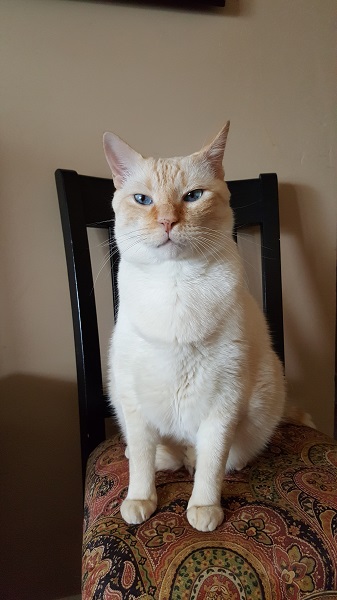
Nounours: Please to not underestimate the healing powers of my purrs.

Nounours: Please to not underestimate the healing powers of my purrs.


8). I actively express my compassion for others in one way or another, however small.

Example: I don’t have time to physically go and volunteer at homeless shelters, so I choose to do my part by providing with water. I make sure to have one or two small bottles of cold water with me when I leave the house, especially in the hot months.

We buy generic water in bulk, keep the bottles in the refrigerator, and give them to the homeless when we see them on the street or at a red light. (Admittedly, I try to identify those homeless who are vets, though I’ll give water to any homeless person, of course.) Every time, without fail, the person takes the bottle of cold water with visible – sometimes overwhelming – gratitude and joy, which they express in such an open and heartfelt manner that I’m instantly put in empathetic touch with their plight. Water is never an unwelcome thing. The person usually opens it and chugs it immediately.

Kindness is invaluable for the human spirit.

Giving water to drink means and accomplishes much more than giving change or a dollar. Giving water with a smile is an act that says, “I recognize that you’re a human being and deserving of this basic, life-saving thing. Someone cares about you and your well-being.” I don’t think it’s necessary to explain how showing compassion to the needy can be anything but beneficial to all involved.

9). I set goals for myself and plan things to anticipate.

I believe I devoted an entire blog post to this. Having agenda items to look forward to is a pleasurable thing. It can also, in the worst of times, give us a reason to keep on keeping on.

10). I try to get 7-8 hours of sleep every night. (Still trying. Still mostly failing. But still trying).

This can’t be stressed enough: Adequate sleep and quality sleep are important for optimal physical and mental health and well-being.

11). I count my blessings and nurture my relationships with loved ones.

One word: Gratitude.

Being grateful for what we have – and who we have – is an incredibly powerful reminder that things could always be worse.


Keeping it real.

Keeping it real.


That sums it up: In addition to acceptance, meds, and professional talk therapy, I manage my mental illness by working on physical health, stress reduction, and gratitude. I try.

Lopsided eyes and mild panic: A cautionary tale.

Life changes and I’m back to a routine of walking to work every morning. I’m loving the extra little workout every day! I also walk home three days a week. The big change in the equation is that on the other two days, I take the bus home so I can get there fast, change my clothes, and drive to Mesa for Body Combat. Why? Callaghan now works on-site full-time, and the site happens to be in BFE (very far away, in case you didn’t know the acronym). This necessitates me taking myself to the gym. Which is fine. As long as I can get there!

(The adjustment to Callaghan’s new schedule and location has been a learn-as-we-go process in many ways. Our lives are very different now. And on Monday, I did NOT make it to the gym, because I literally had no way to get there. That was the last time that was going to happen!)

On Wednesday, I got to the bus stop early and wondered what to do with the spare 15 minutes. People-watching opportunities were oddly nonexistent at University and Mill. What else is there to do while waiting? Take a selfie. Or twenty.

I don’t take selfies very often. It doesn’t occur to me because I’m always looking for interesting, stationary subjects to photograph, or I’m stalking my cats with the camera. There was nothing of interest from my vantage point at the bus stop, and my cats were selfishly sitting at home, so I thought it would be amusing to capture a rare moment of myself being bored in an unusual place.

All that happened in the end was I freaked myself out, though. A little bit. Just a little.

The selfies I took showed my eyes looking lopsided. They were mismatched. One eye looked larger and different than the other. This alarmed me because I thought I remembered reading somewhere that psychopaths often have in common a noticeable difference between their eyes. While no one’s features are perfectly symmetrical, the eyes of a mentally unstable person can be very obviously unlike each other. (I know I read this somewhere, but now I can’t find anything about it, of course.)

Thing is, I do live with mental illness in the form of clinical depression and PTSD, but I never thought I looked mentally ill. The selfies suddenly made me feel paranoid. Then I became paranoid about being paranoid, and that made me feel crazier. I wondered if my mental health situation was really what I thought it was, only. And very quickly, the whole thought process took off on a continuous, self-perpetuating loop inside my brain.

To stop the merciless cycle, I deleted all of the selfies.

I went about the rest of the evening not thinking about it. I went home, went to the gym, and went out to dinner with Callaghan, and I didn’t think about it at all.

Later that night, I went to remove my make-up and saw that my eyeliner was thicker under one eye than the other, and the two lines didn’t match in shape. All along, it was my eyeliner that didn’t match! That would do it. Eyeliner can change your face dramatically. Of course the eye with more liner would look larger, and the two eyes would look different with different liner shapes!

I looked like that before I went and sweated at the gym, so I’d gone around at work with lopsided eyes. How fun.

Either I was in too much of a hurry when I was getting ready that morning, or the eyeliner wore off unevenly during the day. The result was the same, though: I looked like a Picasso painting at work, and I almost drove myself crazy wondering if I was crazier than I actually am.

Yesterday morning, I took extra care with my eyeliner. In the afternoon, I took a selfie in my office:


(February 18, 2016)

(February 18, 2016)


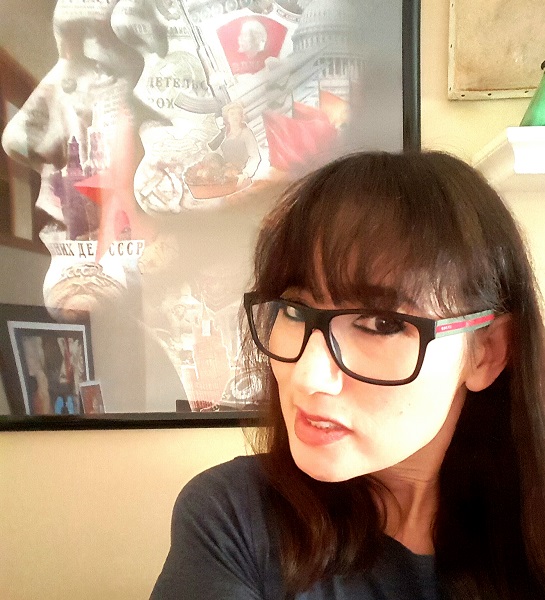
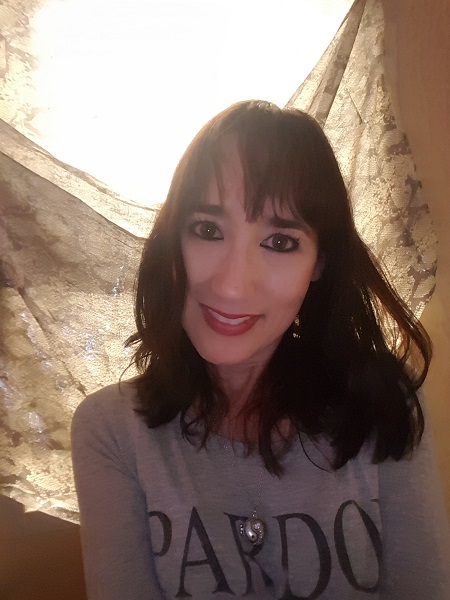
I came out looking more normal, though the left eye still had slightly more liner than the right. Probably only I would notice it, now that I’m hyper-aware of the thickness and shape of my eyeliner. I may have to just set the camera down and back slowly away. It’s hard to get the two eyes to look exactly the same, and I only allow myself 15 minutes to do my make-up before going to work. It is what it is.

The lighting was surprisingly flattering, too, though. Also, it was a rare day that I put on e.l.f. primer under my foundation. I think I like it, after all.

And Callaghan loves his new job!

BodyCombatversary!

It’s the last weekend of March. You know what we did last year on the last weekend of March? We went to our first Body Combat class! This is momentous, guys. On March 29, 2014, I finally got off my ass and ended the longest period of inactivity in my adult life. Planners and agendas are useful like that… you can look back and note such things. I love celebrating -versaries of all kinds. There has to be one for everything! Happy BodyCombatversary to Callaghan and me!

The idea of getting established in a workout routine was hard, but it hurt my brain more than my out-of-shape muscles. I’d been sedentary for so long, and out of training for even longer. We’d actually signed up at our gym a few months earlier, but I hardly went because zero motivation. Callaghan had way more determination than I to get to the gym. When I did manage to drag myself there to half-heartedly walk on the treadmill for 20-30 minutes, all I felt was this weird mixture of boredom and accomplishment and more boredom. Like, YAY, I went to the gym, go me! OH NO… I just spent 20 minutes of my life on a piece of cardio equipment. I could have been doing laundry. The struggle was real, folks, as they say. It’s HARD to get back into habitual exercise once you’ve fallen out of it for any length of time!

Then I decided to check out the group fitness class offerings, and everything changed.

According to my 2014 agenda:

–Tuesday, March 18, 2014: I went to a Body Pump class, just to try it. I didn’t hate it, but I never went back. I think I’m too lazy to do Body Pump. The very idea of making numerous trips to the equipment corner and hauling things over to the floor and then having to quickly change the configuration of the weights in between sets and then hauling all the stuff back to the corner at the end makes me feel annoyed (and bored)! Conclusion: I’m not badass enough to do Body Pump.

(Side-note 1: You know who’s really badass? THE PEOPLE WHO DO BODY PUMP IMMEDIATELY AFTER BODY COMBAT. I marvel at all you guys who do the classes back-to-back! When I’m done with Combat, I’m done. I got nothing left.)

(Side-note 2: I really should start some kind of strength-training routine, though. Shadow-boxing with dumbbells in my garage for five minutes once a week ain’t cutting it.)

–Wednesday, March 26, 2014: I tried a boot camp class. It was super hard. I loved it. Conclusion: Yes!

–Saturday, March 29, 2014: I tried Body Combat. The word “combat” on the schedule caught my eye, and my interest perked up immediately. I hadn’t thrown a punch in almost seven years. Okay, I thought. Let’s try this! So I went, and that was it. I was hooked. Body Combat is simple: I go in and follow the instructor’s commands until we’re done, and that’s it. No fuss, no muss, no equipment! You’re in and out and home before you know it, dripping sweat and feeling accomplished.

Overall conclusion: I made a standing date with the gym for Monday evenings and Saturday mornings (Body Combat), and Wednesday evenings (Boot Camp).

There was no reluctance from that point on; I surprised myself with my 180 turn-around. I’d been against the idea of group fitness classes before I even saw the schedule, because even though I really wanted to work out, in my advanced state of workout apathy and gym-self-motivating-brain-cells-atrophy, the notion of committing myself to a workout “schedule” seemed about as appealing as escaping from jail by digging a tunnel with a teaspoon. Sunken deep in my routine of sitting on my ass, I was perversely comfortable in my little prison cell of inactivity.

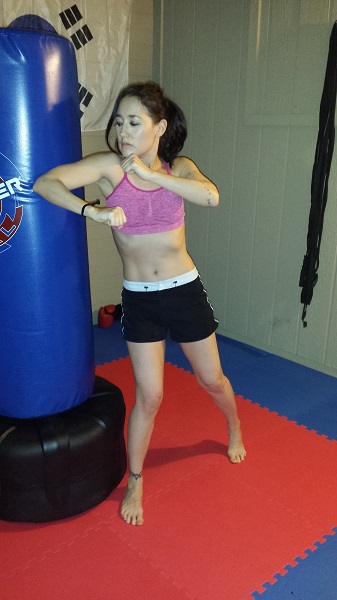
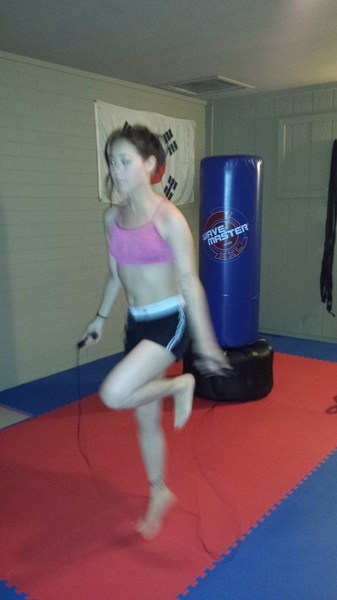
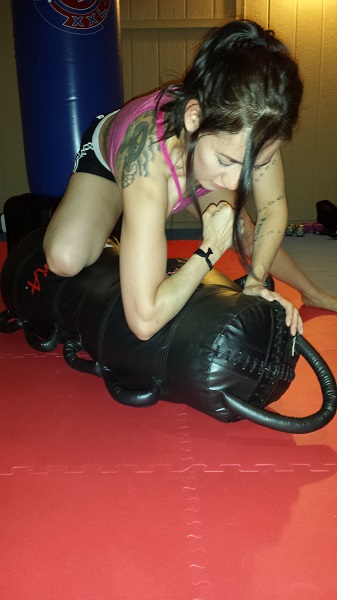
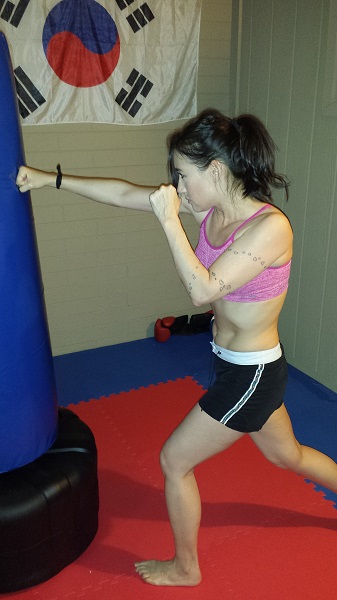
Of course, doing Body Combat brought back the old obsession with actual training (the sweet science addiction never really goes away once it bites you), and this led to the equipment in our garage. We went out there to play a little late last night. Callaghan took pictures.

Excuse the demon eyes. It was late and we had to use the flash in the dimly-lit garage... plus, these pics were taken with my phone, as usual. I still haven't replaced my camera since my last one died.

Excuse the demon eyes. It was late and we had to use the flash in the dimly-lit garage… plus, these pics were taken with my phone, as usual. I still haven’t replaced my camera since my last one died.

Elbows on the WaveMaster

Elbows on the WaveMaster

Jumping rope

Jumping rope

Elbows on the ground

Elbows on the ground

 WaveMaster, bare fists

WaveMaster, bare fists

Now, we do three Body Combat classes per week and no Boot Camp, because the Wednesday night Boot Camp went away and was replaced by the third Body Combat.  I’m not complaining about the extra Body Combat, though I do miss the Boot Camp! In a perfect world, I’d be able to get away from work one morning a week just long enough to do Suzy’s Core, Cardio & More class (Wednesdays), or Geeny’s H.I.I.T. class (Thursdays). If I’m ever off work on either of those days, that’s where I go! Huge shout-out to those ladies, and to our phenomenal regular Combat instructors and friends Izzy, Rebecca and Amelia, and also to our sometimes-instructors Jessica and Diane!

That’s the best part… in the last year, I’ve gained much more than a higher level of fitness with increased energy, strength and balance. I’ve gained new friendships with other class participants and the instructors, themselves.  I’ve also gained something concrete to look forward to, three times a week (looking forward to stuff is so important if you have clinical depression, by the way). Each time we leave the gym, I can’t wait for the next time, and that is awesome.

Happy Friday, Everyone! =)

The Darkest Hour, Part 2

I’ve been wanting to continue on the theme of my Darkest Hour post, and I have to confess that I didn’t give it as much thought as I would have liked – but even as I finish writing this, sitting here on my lunch hour at work, I realize that it’s useless to try to compact the mysteries of nebulous life problems away into neat little lines of text. So this is just me, not being a psychologist or a counselor of any kind – there’s my disclaimer! – rambling a little about life and crises and regret and goals and action.

Mainly what I want to say is, things aren’t always as bad as they seem.

You know how when you stare at something really hard, your vision blurs until the thing becomes obscured? Or how, after searching frantically for something, you give up, only to later realize that it was sitting out in plain sight all along… it was right there, but you couldn’t find it? The answers to the biggest questions in life are often like that, I think. They’re maddeningly invisible in their obviousness.

In fact, it seems that quite often, issues arise the more we try to see, look for, search for or find things. When using variations on the sense of vision doesn’t help us to figure things out, it might be time to change strategy.

Furthermore, when searching for “what I want,” that (whatever it is) often turns out to be a mythical beast, and why waste time and energy chasing something that may not even exist? Our hearts’ desires are often illusory in the sense that sometimes, we think we know what we want, but when we get it, we realize that we want something different!

For me, the more worthwhile challenge is to open my mind to knowing what I want – more in a process of discovery, rather than a searching for. If I (at least) believe that I know what I want, I can take steps toward getting it. I can set goals and strive to make things happen. Motivated by the ambition to reach my goals, I’m exempt from the struggle to find the answer to ultimately meaningless questions like “what do I want to be when I grow up?” and the tedious preoccupation with “finding myself” that I’ve seen bog people down until they’re lost in the confusion they’ve made of their existences. I try not to overthink my life and myself.

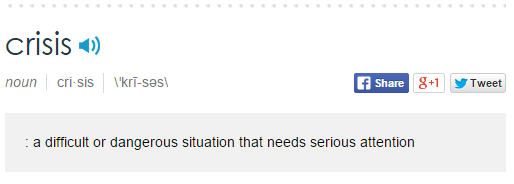
And as much as I like to joke about it, I don’t think I actually believe in the concepts of “mid-life crisis” or “identity crisis” or “existential crisis.” There’s just crisis, and the practice of labeling it and applying definitions to it only gives us more tools of procrastination we don’t need.


thatasianlookingchick.com-merriam-webster-crisis


A difficult or dangerous situation that needs serious attention.

Of course we all experience crisis, but everything can’t be a crisis. Just because we’re dissatisfied doesn’t mean that we’re “in a crisis.” There are degrees of difficulty and danger, for sure, and it’s always good to be aware (stay alert to stay alive!), but funneling our energies into taking the situation apart from the inside out usually doesn’t lead to anything but mental and emotional fatigue and frustration. We end up building apathy into the self-defeating cycle we’ve created, and that’s where we get stuck.

It’s blissfully liberating to realize that we can use that same energy to fuel our own productivity… and on our own terms.

It’s worth endeavoring to become a creator and collector of goals, both long-term and short-term. It’s worth trying to become a dedicated collector and keep those goals in sight, lined up all nice and neat.

Success, victory and triumph are personal, even intimate degrees of measure we construct for ourselves. It’s not just the day you win at a competitive event wherein everyone can witness your badassery. It’s more meaningful the day you can say, “Hey! I’ve finally stopped making that one mistake.” It doesn’t matter if you had to make that mistake five or ten or a hundred times before that. The growth still happened. You developed as a person. YOU did that for yourself, and in doing that, you gained freedom from old restraints.

Regardless of where I am at any given moment, as long as I can look back at my own life and note progress happening somewhere, in some realm of my being and existence, I feel successful.

And what of regret? I want to address this briefly, too, because it’s another thing that can drag us down.

Regret doesn’t have to be a spirit-crushing specter overshadowing our lives. Aside from the inevitable random moments of thoughtlessness in which we speak or behave carelessly (if we’re human, there’s no avoiding these moments – all we can do is learn how to handle our blunders with grace), there are difficult times during which we’re likely operating in “survival” mode, meaning that our thinking is foggy, or we aren’t thinking, at all. We’re distracted and worn-down by an onslaught of challenges that causes us to see everything as a threat. We’re propelled to action, and sometimes, in the urgency of the situation, we misdirect that action, making decisions we might later wish we hadn’t. We can make bad judgment calls regardless of the goodness of our intent. It just happens sometimes.

But it’s easy – too easy – to look back on these moments years later and feel regret, guilt or shame when we’re no longer under duress. Berating ourselves from that detached standpoint isn’t fair to our past or current selves. We can wallow in regret, or we can grow from our experiences by taking away lessons offered through them.

Regret is something we can manage by recognizing any mistakes that may have caused it and accepting that we made them, with gracious allowance for the external factors that comprise “circumstances.” Then we can gather our hard-won nuggets of wisdom and relish the satisfaction of a more mindful moving-forward. We can proceed with a purposeful energy infused with something akin to defiance and rebelliousness, that revitalizing energy that allows you to be the surfer standing on two feet at the crest of the wave not only with determination, but with joy, as well. We can commit acts of joyful courageousness on our quest to attain our goals. There’s a sense of liberation there, and the view is stunning. 

This brings me to the subject of balance, but I’ll save that for another day.

I saw American Sniper. Here are my thoughts.

Somewhere around October-November, we found out about the upcoming film American Sniper. It was set to open on Christmas day. We were looking forward to it, and I liked the idea that two years in a row, the newly released movie we’d see on my December 27 birthday would feature Bradley Cooper.

As it turned out, the movie’s release date got pushed into January, so we didn’t get to see American Sniper on my birthday. Interestingly, though, the holiday movie we did go to see on December 27, Big Eyes, also featured an actor from last year’s birthday movie: Amy Adams! We saw American Hustle (Amy Adams and Bradley Cooper) on my birthday in 2013, and Big Eyes (Amy Adams) on my birthday in 2014.

I like Bradley Cooper. It’s not a crush. I’m not obsessed with him, and I don’t race to the theatre just because he’s in a movie, but I am a fan. I’ve never seen him flounder in a role, and I’ve never seen a film of his I didn’t enjoy or appreciate in some way. Bradley Cooper in a movie usually means that I’m going to like the movie, and this is also true about Amy Adams and a few other actors (Jake Gyllanhaal comes immediately to mind); Callaghan and I are almost always on the same page, which is good. It’s more fun spending money on movie tickets if we strongly suspect that we’ll really like the movie.

So we saw Big Eyes on my birthday, and we enjoyed it, and we continued to anticipate the release of American Sniper. When the day arrived, we went to the theatre with our favorite action-flick movie-watching partner-in-crime, Jason, and I didn’t know what I was walking into. Somehow, I had the idea that the film was about a veteran who was using his lethal military skills for some grand operation in the civilian sector. I didn’t know that I was walking into a war movie. Neither did I know that the story was based on an autobiography/events that happened in the life of a real person.

And I’m glad. I’m glad that I didn’t know it was a war movie, because I generally avoid war movies. Had I known, I would have dropped American Sniper off my to-watch list, and I would have missed out on an incredible movie.

Yes, I know. I’m a Buddhist and a mostly-vegan vegetarian and I’m all about peace and compassion, but I highly appreciated American Sniper. This might seem incongruous, but it’s really not. For one thing, just on the artistic level, I thought it was a brilliant, finely-wrought film. I thought Bradley Cooper gave a tremendous, nuanced performance. I thought Clint Eastwood’s handling of the project was masterful.

Where can I even begin to try to explain my appreciation beyond that?

I guess I should start with the disclaimer that I’m not motivated by politics when it comes to art. I’m a registered Independent, anyway… my political views do tend to lean in a certain direction (if you know me well, you know what direction that is), but there’s a reason why I won’t join a particular party. Also, I generally stay away from the subject of politics on social media sites. What I’m trying to say is that I don’t intend to talk politics here today or any day. I get that it’s hard to avoid politics where this film is concerned, but I’m going to try to avoid the damn politics.

Then I should point out that I’m a combat veteran. I spent six months in Saudi Arabia, Iraq and Kuwait during Operations Desert Shield, Storm and Sabre, from the beginning of December 1990 to almost the end of May 1991. The ground war in January took all of two days, and the whole thing was rather anti-climactic after the airstrikes, but somehow I managed to get embroiled in the only real action American foot soldiers saw pushing through Iraq. I ran Commo (wire, radios) in a segment of a ground ambulance unit, and our convoy was comprised of mostly medics from my Garrison unit in Germany, along with some infantrymen, American National Guardsmen and women, and a few British soldiers. We were ambushed, and it was intense, and I brought that personal history with me going into the movie theatre to see American Sniper, not knowing, as I’d said, that it was going to be a war movie.

Now, about that Buddhist thing, since I know that it’s confusing to many people. I’ve been Buddhist all of my life, and I’ve been a martial/fighting artist for more than half of my life, and no, contrary to the popular opinion of our times, this does not create a contradiction. Buddhism and the fighting arts are not mutually exclusive. If you can understand this, then my admiration of American Sniper shouldn’t seem contradictory, either.

Rather than going into a tedious academic tangent on the principles of eastern philosophy, including the meaning of the yin-yang symbol, I’m asking that you hang with me for a minute here!

Buddhist monks in the Shaolin temple of ancient China were resourceful and inventive. They developed seitan, a popular protein-rich meat substitute made of wheat gluten, so they could avoid eating animals. They also developed Shaolin Kung Fu, a martial art that enabled them to kill with their bare hands and laid the groundwork for basically all eastern martial arts thereafter. What’s more, the full spectrum of the Shaolin martial arts system includes fighting with weapons. The “Buddhist warrior” is actually a thing, and it always has been. I’m not saying that ALL Buddhists are warriors. I’m just saying that warriors in the ranks of Buddhists have existed for ages, at least as long as there have been temples to protect. Long before Bruce Lee, there were the Shaolin Buddhist soldier monks.

Hard to believe that there’s a history of martial arts bad-assery in Buddhism, right?

Enough about me and my background. Returning to American Sniper, I want to talk about the “problem” of the veracity of (every detail of) Chris Kyle’s story. He apparently made some claims in his book that aren’t true. In my opinion, just from my perspective as a literature major, this is normal. Biography/autobiography/memoir/creative non-fiction and, loosely, historical fiction all rely on facts and factual events for the backbone of the stories within, but there’s usually good reason and/or artistic justification for alteration or invention in some places, and authors take this kind of creative liberty all the time.

Take, for example, a staple of children’s literature well-known and loved by most Americans. The Nellie Olson character in Laura Ingalls Wilder’s “Little House” series of books didn’t actually exist… she was an amalgamation of two real-life figures from her childhood. Because Laura Ingalls Wilder also altered the chronology of her family’s travels (reportedly for the sake of simplicity), she took two classmates from two of her schools in two different geographical locations and blended them together to create the one insufferable character we know as “Nellie Olson.” (The real Nellie Olson was one of the two classmates Laura Ingalls Wilder used to create the fictitious one.)

This is a well-documented fact, and yet I’ve never heard anyone say that Laura Ingalls Wilder’s stories are meaningless because she “made up” the character or “lied” about the trajectory of her family’s pioneering path, nor have I heard of anyone calling her out on any of the other half-truths, embellishments or omissions that resulted for artistic purposes. I never heard anyone say that because of all this, Laura Ingalls Wilder is not to be trusted or believed, and that the attention paid to her stories is undeserved. I never heard anyone say that the worth of other art based on the books she co-wrote about her life – namely, the world-famous Little House on the Prairie television series – was invalidated by her “lies.” I never heard anyone complain that the T.V. show was “mendacious” because Laura Ingalls Wilder changed some things, omitted things, and flat-out made other stuff up.

We know that she did these things, but we still accept her work as autobiographical. That which wasn’t real didn’t cancel out all that was real. Her story is still her story, and Chris Kyle’s story is still Chris Kyle’s story, and just because Laura Ingalls Wilder’s tone was demure and so many people dig stories about pioneer life more than they dig stories about soldiering life doesn’t mean that by majority opinion, we can have a double standard. If we’re going to call Chris Kyle a liar, then we’re going to have to call Laura Ingalls Wilder a liar for the exact same reasons, and we don’t want to do that, now, do we?

And while we’re on the subject, let’s think for a moment of how Laura Ingalls Wilder “glorified” and “romanticized” how her Pa decided to drag the family into Indian Territory and knowingly illegally squat on the Native Americans’ land, and how Laura Ingalls Wilder plainly recounted her parents’ racist attitudes and sentiments regarding the “savages” (sound familiar?) – have you ever heard anyone lambasting her for this dubious aspect of their “courageous” pioneer life? Neither have I. Needless to say, the storylines in the television series’ episodes conveniently omit any mention or reference to this part of the Ingalls’ “adventures.” Most everyone still loves the show.

But people are sure enjoying harping on Clint Eastwood and Bradley Cooper for “glorifying” and “romanticizing” the darker sides of Chris Kyle and his story.

Finally, I want to say that it’s interesting how the people shouting the loudest about how Chris Kyle was a lying psychopath (and no hero at all) are the ones who never spent a day in his or any other soldier’s boots. Now, I didn’t know Chris Kyle. I didn’t know him before, during or after his service, nor am I a psychiatrist. For all I know, he could have been a psychopath or a sociopath or whatever other -path you want to call him… but I don’t care. I don’t care if Chris Kyle was the kind of guy who’d help an old lady cross the street, or the kind of guy who’d push an old lady off a cliff. Because what I do know is that combat military training and circumstances change you in ways that civilians can’t even begin to fathom. What you were before is rendered nearly irrelevant. Even emerging from regular old Army basic training (Chris Kyle underwent Navy S.E.A.L. training, which is much more intense), you’re different than you were before you went in.

In basic training, you’re broken down from the inside out, with the whole point being to re-build you into something you probably weren’t before you went in: a killing machine that can be set into action when the circumstances call for it. The mental and physical conditioning you undergo in order to serve in combat is complete. I’m talking about the average person here. Now imagine that instead of being an average person, you were already an expert shot accustomed to taking lives (as a hunter)… and imagine, too, that your military occupational specialty is killing.

Someone’s got to do it, guys. The military is an establishment in which there’s a need for many roles, just like in civilian society, and while all soldiers are required to be conditioned in the basics, everyone has to choose an occupational specialty. Some soldiers are cooks. Others are band musicians. Others work in supply. There are the tankers, the ammo soldiers, the administration office-working soldiers, the morgue soldiers and the medics and the mechanics and the military cops and the JAG (legal) corps and the signal corps, the soldiers responsible for ensuring communications in the field (what I did – my 31K occupational title was “Combat Signaler.”) And so on, and so forth… and then you have the soldiers whose specialty is killing. These are the infantry, the “grunts.”

Regardless of your occupational specialty, though, all soldiers function the same way in combat zones, and again, to reiterate, this is what basic training is for. When thrown into a combat situation, the conditioning deep inside you surfaces, enabling you to automatically act according to the situation, and I’m sorry, but combat situations don’t usually involve making butter, choosing fabric for dresses, or embroidering. Pa Ingalls is not going to bust out his fiddle at the end of the day and make everyone laugh merrily as they sing along to his folksy songs.

When I was 18, I went to basic training and came out different than I was before, because that is what basic training is designed to do. Not only are you different, but you’re also no longer your own person. You become government property, calibrated to respond and operate on a situational basis. The minute you raise your hand and take that oath, the Constitution you’re charged to protect no longer even applies to you. You opt out of those rights in order to protect them. It’s the Unified Code of Military Justice (UCMJ) for you!

A day or two before Christmas 1990, we were out there in the vast, cold and empty Saudi Arabian desert when we were told that Sadam Hussein had threatened an attack as a “Christmas present” for the Americans lying in wait, meaning, us. We went into high alert for an indefinite period of time. I remember my 22nd birthday very well. I spent the entire day in a foxhole in the biting cold, suited up in MOPP 4 (head to toe chemical protection gear) with a full bandolier of ammo strapped around my chest and my M-16 at the ready, and again, I came out different than I was before, because that’s what happens when you spend hours on end with every cell and nerve of your being waiting to either kill or get killed. Just being in that situation day after day changes you. Even if “nothing happens,” you can’t ever be the same again.

A few weeks later, the ground war started, and we switched gear from alert to action. We convoyed out of Saudi Arabia to follow the front line through Iraq, destination Kuwait. We were a ground ambulance convoy in our Cut-V’s and Hum-V’s, and we saw and dealt with everything you’d expect to encounter on a battlefield. Then we were ambushed. There were Iraqi snipers. There were detonating landmines. There were casualties. Afterward, there were smoke grenades and medevac helicopters. I’m not going to go into the details of what I did and saw, but you can bet that again, I was a different person by the end of it.

Now, take my modest little combat experience and quadruple it and give it another hefty boost for increased severity. Chris Kyle couldn’t possibly have ended up being the same person he’d been before any of his four tours of combat duty, whatever that may have been. He killed people, as we were all prepared to do, as Navy S.E.A.L.S. were expected to do, and I would venture to guess that he saved many more people than he killed. Whether I “agreed” with the Iraq War or not, I’m grateful to Chris Kyle for his service, and for the service of all men and women in uniform in all the branches of the Armed Forces, regardless of the conflict or the reason for it or behind it, or the duration or severity of it, or the number of times they deployed, or my opinion of it or your opinion of it or anyone’s opinion of it, or anything else.

I’d like to think that if I never lived the experience of being broken down and built back up to human war-machine specs, if I never set foot in a combat zone, if I never mentally prepared to suffer and die under chemical attack or by gunfire or other ordnance, if I never swallowed 12 mysterious pills a day “in case of chemical attack”… if I never lived a day of my life serving my country… I would recognize that I’m not in a position to judge Chris Kyle.

Like him or not, Chris Kyle was a hero. As far as I’m concerned, everyone who voluntarily raises their hand and swears away their own constitutional rights in order to protect yours is a hero, whatever else they may be, and whether they go to war or not. To try to posthumously shame Chris Kyle for being the lying asshole he maybe was is to miss the point of American Sniper. Deriding Eastwood and Cooper for taking part in “glorifying” anything is also an exercise in missing the point.

Aside from all of this, what’s really important here, of course, is that we found American Sniper to be a great piece of cinematic art in and of itself. Clint Eastwood and Bradley Cooper did a damn fine job, along with everyone else who put their energies into the making of the film. I’m saying this, and I don’t even like war movies!

So, American Sniper? We recommend it. It’s not easy to watch, and I wouldn’t necessarily call it “enjoyable,” but it’s an amazing film.

On that (hopefully cheerier) note, Happy Friday, All!

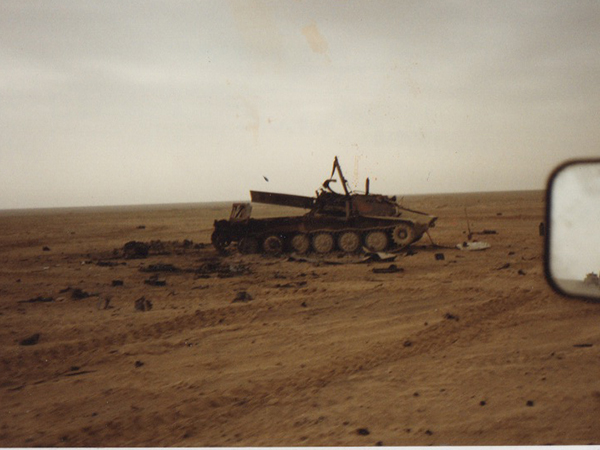
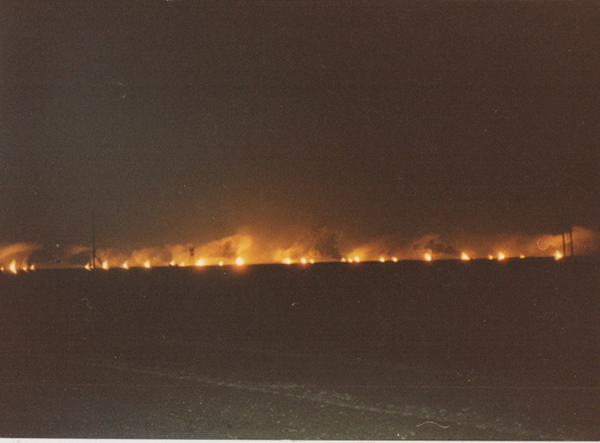
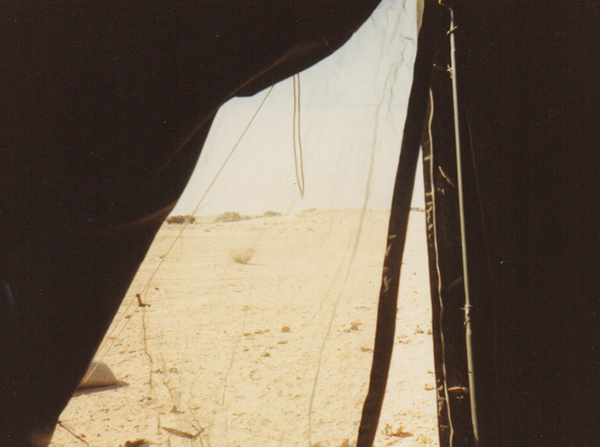
(Here are some photos I took in the war):
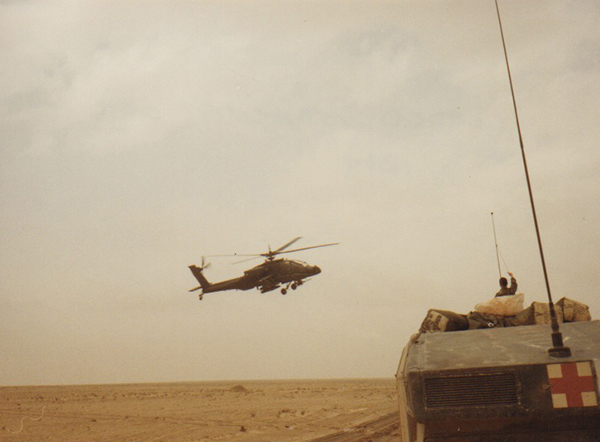
 

The first Hum-V ambulances....

The first Hum-V ambulances….


Random tank in Iraq

Random tank in Iraq


After the ambush, we continued on without stopping to sleep. This is what Kuwait looked like as we approached it.
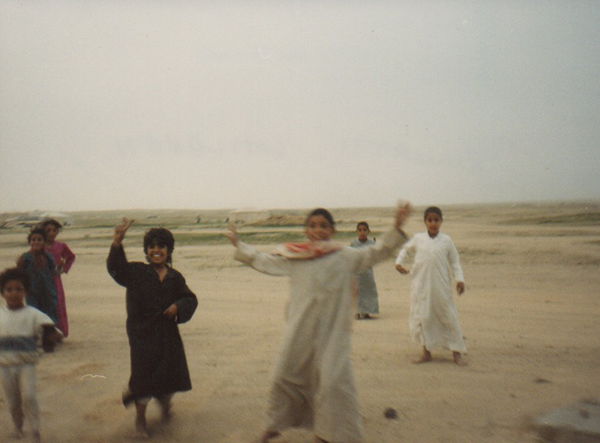
After the ambush, we continued on without stopping to sleep. This is what Kuwait looked like as we approached it.


As we moved through Kuwait, children came running out from nowhere to greet us, happy and excited

As we moved through Kuwait, children came running out from nowhere to greet us, happy and excited


After the ground war in January 1991, this was mostly my view until we left in May.

After the ground war in January 1991, this was mostly my view until we left in May.


Thanks for scanning them, Callaghan!

Addicted to Fear? (PTSD post.)

Q: What happens when you watch the American Horror Story: Freak Show premiere and the first two episodes of Stalker all on the same night?

A: The next time you’re alone in the house, ALL THE LITTLE NOISES will cause you to jump and imagine that the most terrifying clown you’ve ever seen is creeping around your windows.

And, if you’re kind of warped, like me, you’ll love it.

Twisty the Clown

Twisty the Clown

Fear is a mysterious emotion. It can be taught, or it can be intuitive. It can be provoked by things we perceive with our own senses, or by others’ senses. Fear as a response to external stimuli real or imagined can also be unpredictable.

Twisty the MURDER Clown, that is.

Twisty the MURDER Clown, that is.

I have phobias, meaning that I experience irrational fear in response to specific things. I also have PTSD, meaning that I have a few known “triggers” floating around in a deep lake of more inexplicable, unknown causes of panic. The resulting inner havoc is predictable even if its cause is not… it’s the familiar old Armageddon of panic and stress boiling in my core, rippling outward through my body like a fire spreading through a house. It feels like I’m being consumed. Sometimes, it even feels like I’m going to die, or like I have to die. I actually take medication for this. Throw in the by-product of clinical depression just to balance it out, and there you have the main reason I live for my body combat classes at the gym three days a week. I enjoy them because they’re amazing, yes, but I also need them for medical reasons. Intense physical training on a regular basis helps my brain chemistry better than anything.

So it’s a mystery to me why, when a former boyfriend introduced me to the creepy PlayStation game Silent Hill (the only video game I’d played since the ‘80’s), I quickly became addicted and couldn’t wait for darkness to fall every night so I could huddle in the shadowy corner of the bed with all the lights out, trembling and listening to the discreet yet horrifying sound of snow crunching beneath my feet (leave it to developers of Japanese horror to make the sound of snow horrifying) as I walked through the abandoned town in search of my daughter. You would think the eerie sense of being watched and the unpredictable sightings and attacks would have sent me into PTSD Armageddon, but instead, I found myself craving more.

It’s odd, this thing about the horror genre in pop culture. If scary movies, television shows, books or games manage to provoke fear or stir up the creep factor even a little bit, which very few of them can do, by the way – my favorites are the ones that can – I just twitch a little and then run back for more. Yet, the sight of a sewer roach encases me in fear and leaves me traumatized for days. Why is that?

I would venture to guess that the PTSD lurks behind this incongruity. Fear strikes, and in that moment of skyrocketing adrenaline, I’m instantaneously alert and on edge. Maybe, in some perverse way, I love it because it makes me feel alive… alert, alive and ready to act, and when this response comes in the wake of stimuli that I know is fictional, I can just enjoy the rush. There’s no real-world threat in fiction. (A roach is not a formidable threat, but it is real.) Maybe I’ve become a “fight or flight” response junkie, though I don’t think I’d go so far as to say I’m addicted to adrenaline, a phenomenon that some people apparently experience. For me, in the case of creepy movies and T.V. shows and books, maybe I’m more just hyper-intrigued by the fear of the unknown, and of the (horrifying) possibilities. Neither am I sure that there’s much of a difference between this kind of fear addiction and the kind of garden-variety thrill-seeking that leads people to go bungee-jumping (I am not a thrill-seeker of the bungee-jumping variety). Whatever the case, I find the psychology of fear to be fascinating. Fear is terror-provoking, thrilling, necessary and fun. What emotion other than love covers all of that?

My affection for the horror genre pre-dates my PTSD, so perhaps that’s significant, as well.

I also think that it’s my PTSD that drives me through whatever martial/fighting arts training I’m doing, especially when my energy stores are low, though I’d loved combat sports long before the PTSD, too. In high school, I was the girl who demanded that the P.E. faculty allow girls to take wrestling, because that was what I wanted to do, and I was outraged that only boys could take it. (In the end, they acquiesced, but only because I got other girls to sign my petition, indicating that they would take it with me. We were only allowed to wrestle under the stipulation that we’d wrestle each other, rather than the boys. Haha!) (I don’t think that anyone was surprised when I joined the Army after that.)

On the tail of that tangent, let’s all take a moment to acknowledge that Halloween is just two weeks away. I’m beside myself with glee. We’re in a house now, which means that we get to give candy out to trick-or-treaters. I wonder how many American Horror Story Twisty the Clowns we’ll find on our doorstep Halloween night? I can’t wait to find out!

Happy Friday, All!

The Darkest Hour

Right now, as I witness a number of my friends working through some pretty daunting life challenges with strength and courage, I’m inspired to muse on my default coping strategy. I prefer the word “strategy” to “mechanism” because it’s action-oriented, but the one I have in mind is actually more of a simple trick.

The idea is to navigate hardships with the cautious confidence of a surfer standing, feet planted on her surfboard, on the crest of the wave rather than flailing every which way in a murky turmoil, struggling in the lung-burning angst of one who gets pulled underwater and tossed around… right? Like everyone, I’ve spent a fair amount of time in the bewildering throes of the latter. I thought I’d relay the trick that pulls me up and out, since I’ve been thinking about it.

That is, I think about words and language a lot.

I’m talking about popular axioms in the forms of adages and idioms, proverbs and platitudes. Many of these are interchangeable, these banal sayings and feel-good, preachy expressions, and they’re clichés. They’re filler material in our lexicon, the expressions that writers are advised to avoid. If we want to write in those terms, we’re told, we can apply for jobs writing for greeting card companies or cranking out fortune cookie fortunes. We’ve developed such a knee-jerk reaction against these age-old “words of wisdom” that our eyes start to roll before we even finish hearing them, and we tend to feel insulted when someone throws one at us in the depths of our struggles. A saccharine platitude weighed down with didacticism all dressed up in a cheery tone of voice makes for a hell of a life raft, even if the people offering it have their hearts in the right place.


Definition: Adage (Merriam-Webster)


But I’m thinking maybe it’s different when you repeat those tired, trite expressions to yourself, because they have a way of getting me through when I’m the one using them to coach myself along. In keeping with the definition of “filler material,” the words are always right there, spilling out over the edges. The trick is to start paying attention to them, at which point you can turn them over in your head, repeatedly, performing a sort of mental twiddling of the thumbs. Then the expression takes on the function of background music, and somewhere in the repetitive space of this thinking about it without thinking about it, a sedative effect comes over you, numbing you so you can forge ahead. Dull pain is still pain, but it’s manageable, and you can work through it.

Maybe I’ve just described the power of a mantra, which would suggest that you don’t have to read tomes on Eastern philosophy, convert to Eastern religion or become a yogi to experience this effect. Ordinary Western sayings can work as mantras, too.

A perfect cactus bloom from my house in a past life.

A perfect cactus bloom from my house in a past life.


It began in elementary school when I read Laura Ingalls Wilder’s On the Banks of Plum Creek and came across the adage “the darkest hour is just before dawn” for the first time. Aside from finding this to be a metaphorically beautiful expression, it just resonates in a way that other, similar sayings don’t.

Now, when the cyclical rhythm of life gears down to “Low” and I find myself spiraling off into what I call The Great Abyss of WTF for a stay of indefinite duration, that old adage comes clanging back at me like a rabid cow with tricked-out bells… yet somehow, the accompanying sound is sonorous rather than cacophonous.

“The darkest hour is just before dawn.”

Many of these expressions of age-old wisdom often ring true. It’s maddening, but expressions get overused for a reason. “Things will get better.” Circumstances in life usually do get better, but not, for some reason, before they get worse. In fact, things often have a way of getting exponentially worse just when you’re thinking that they couldn’t possibly. Right after that, though, something happens… you reach a breaking point, and then you get a consolation prize! That’s the magic. The breaking point is where the magic happens. The breaking point creates a wellspring of potential. Disaster prompts action, action leads to change, and change leads to improvement. Or, change leads to sub-sets of challenges – small steps, baby steps – that will inevitably lead to better times. “The darkest hour is just before dawn” is a potent reminder. In retrospect, I can spot the breaking points in my life and see clearly that they were just turn-around points, flashing with the lessons I needed to learn.

“Hope for the best, but expect the worst” is also helpful. For me, this proverb provides encouragement to proceed with cautious optimism and requires just a bit of old-fashioned samurai stoicism.

“This, too, shall pass” comes to mind, but this expression is more of a reassurance than a warrior cry for perseverance. It’s useful when you want to will yourself through some sort of unpleasantness. It’s what you think when you’re sitting in the dental hygienist’s chair and she’s earnestly working away with that sinister, metal tartar-scraping hook thing pierced halfway into your gum-line and she hits a nerve – zing! – every other second, and you find yourself holding your breath while your fingers curl into fists until your nails dig into your palms and sweat pops out of the pores all over your body. Breathe. This, too, shall pass. (And then it does, and then you’re fine, until the next cleaning appointment rolls around six months later.)

It’s when situations in life get tough that I brace myself for the darkening and I actually hear those words in my head, repeatedly, mantra-like: “The darkest hour is just before dawn.”

It’s true that “things could always be worse,” but this adage doesn’t inspire or motivate me in any way. It’s merely an observation, and an annoying one, at that. “Things could always be worse” is the “You don’t have the right to feel that way because that’s a FIRST WORLD PROBLEM” adage.

Yet, perspective is a profound thing, and perspective is the take-away from “things could always be worse.”

For instance, when I came back from six months in Saudi Arabia, Iraq and Kuwait during the Gulf War, I didn’t have a bad hair day for literally years, because the concept of a bad hair day is inconceivable once you’ve lived in the desert with no semblance of civilization for six months and your main concern each day is whether you’re going to live to see the next. Good/bad hair doesn’t factor into survival mode. I was able to wash my hair every once in a while out there, but it was a tedious and dicey affair (you’re vulnerable when you wash your hair!) that required using rationed water. We had small bottles of Pert (Shampoo and Conditioner in One!) that were either issued or donated… I don’t remember which, but I remember that its fresh, green scent in my hair was an unspeakable luxury once the hair-washing production was over. (I haven’t used Pert since, but I would probably recognize its scent instantly.) That’s what clean hair amounted to: an intermittent, tense luxury. 23 years later, I now certainly do have bad hair days, but I haven’t forgotten. It’s the little things, and I don’t take them for granted.

“The darkest hour is just before dawn” is my favorite adage because it does inspire and motivate me. It turns out that a lot can be done in the dark. You can do some of your best creative thinking in the dark; sight deprivation amps up your remaining senses, and with that bolstering comes an almost supernatural ability to strategize your way out of your predicament. Perhaps this is partially why some of the most compelling poets and writers in history wrote from dark places, oftentimes chronically. It’s like The Great Abyss of WTF was a grungy old motel they checked into one night and never left. (Sadly, many brilliant poets and writers died in that darkness, dissolving into addiction or turning to suicide… but they left us with a body of written work that will inspire and captivate people until the end of time.)

Another thing I do when facing extreme difficulty is I veer in the opposite direction and convince myself that the worst-case scenario will happen, and I focus on that. I plan for it. This may sound counter-intuitive, and it goes against all the variations on the “Envision your perfect situation and it will happen!” theme popularized by the self-help genre of the last 20 years. (The Secret, anyone?) But somehow, focusing on the worst rather than on the best has been a tactic that’s been of enormous benefit to me. (Here, I’m tempted to segue into the topic of Buddhism, but I’ll save that for another post.)

To focus on the worst is to put yourself in survival mode, and there, you begin to craft an action plan, since there’s nothing else to do. Once you’re in survival mode, you’re forced to take steps, many of them drastic. The alternative is to perish. That phrasing might sound dramatic, but that’s how it feels… and besides, presenting yourself with a life or death proposition works. As you funnel your energy toward that darkest imaginable place in your future, you suddenly find a). solutions to problems in unexpected places, and/or b). that while you were busy preparing for the worst, things were actually getting better… and the amelioration of your circumstances came about while you weren’t looking directly at them.

This is not as passive an approach as it sounds. The human mind naturally searches for solutions in everything, I think, even if we’re not aware of it. We take pleasure in solving mysteries and riddles and identifying patterns and finding answers. With our vision muddled, we discover other ways to make sense of things. Such as it is that things evolve… and that evolution happens in the dark.

The darkest hour is just before dawn.


Spring in the desert is always the dawn!

Spring in the desert is always the dawn!


What I’ve come to realize is that the darkest hours are important. The darkest hours are hard, but they’re also the pivotal, life-altering and transformative times that are essential for growth and the wisdom we need to prepare ourselves for future hardships, because there will always be future hardships. No one is exempt from the vagaries of life.

A penultimate favorite quote: “In the end, everything will be okay. If it’s not okay, it’s not the end.”

Now those are fighting words! If it’s not okay, it’s not the end.

And finally, you know what they say: “When nothing goes right, go left.”

Which is about change. It’s all about change, and progress through change. It’s revitalizing. It allows me to be the surfer standing on two feet on the crest of the wave not only with determination, but with joy, as well. There’s a sense of liberation there, and the view is stunning.