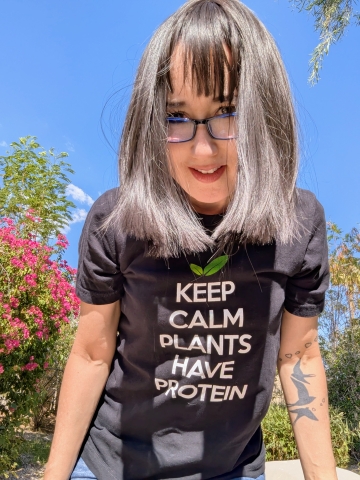
Open Letter from an Autoimmune Patient to Those Concerned About Her Vegan Diet.

Yours Truly on 07/17/2025. Hi.

Dear all who are concerned:

I have Sjögren’s Syndrome, a systemic autoimmune disease, and it’s with gratitude that I hear your doubts and qualms about the food that I eat. You’re worried about me. You’re worried that I’m possibly making myself sick, keeping myself sick, or making myself worse with my plant-based manner of fueling my body. I’m writing this letter in the hopes that it will ease your minds.

Instead of focusing on what’s wrong with me, focus on what’s right with me.

First, though, to review:

Between Sjögren’s Syndrome, itself, and the complications I’ve developed, I’m uncomfortable and in pain all of the time. I have a lung that’s structurally damaged and getting worse, and a stomach that’s 60% paralyzed. Sjögren’s arthritis and tendonitis leave my fingers, hands, and wrists painful and stiff; I currently can’t drive, hold a pen to write, or use my hands to push open a door.

First thing in the morning, because of my severe dry eye, I squint through one eye at a time as I feel around for the eye drops. Getting the drops into my eyes is difficult because it’s uncomfortable to keep my eyes open long enough to deposit the drops. (I often miss, re-squeeze the bottle, and end up with drops running down my face.) At the same time, my mouth, throat, and tongue are so dry, it’s an ordeal to swallow and to speak coherently. My finger joints are the worst when I wake up. I can’t close my hands into fists.

I push myself through my morning chore routine and declare victory when I can get the bed made before noon. Morning going-out plans require a self psych-out and a ride on a choppy wave of adrenaline. It helps if I’m excited about where I’m going. When I arrive, no one can tell that I battled to get there, and I relax onto the warm sands of another win.

A lot goes into the execution of an average day as I listen to my body and respect her limits. I know I’m going to be working out, and that I’ll need to show up for myself.

All of this said, I can’t feel too badly about my everyday trials and tribulations when I think of some of the things that I’m able to do, despite my chronic illness.

Examples:

–I can pull myself up in bed and swing my legs around using just my abdominal muscles. With my core strength, I can easily get up from a seated or lying down position without using my hands or other assistance. (Important because I can’t use my hands; they don’t flex backward, my wrists are weak, and the pain is a problem.)

–I can hold a 4+ minute plank on my knuckles. (Important for the same reason as parenthesized above.)

–I can walk five miles, up and down inclines at varying speeds, wearing a 12-lb weighted vest.

–I can work out nonstop for an hour doing LM Body Combat and Body Step classes, which incorporate HIIT cardio.

–I can run up and down stairs.

–I can lift weights. Using modifications where necessary to accommodate the disability in my wrists, I strength-train with weights at home, or on machines at Planet Fitness.

Amazing, isn’t it? Why focus on what’s wrong with me when I can yet do all of these things? Clearly, I’m doing something right.

I work out through the pain, and I get it done. These days, I work out six days a week. Regular exercise is highly encouraged by my doctors; it’s practically prescribed.

Imagine! I’m chronically ill with pain, discomfort, and a slew of medical challenges, yet I feel good in my body, and I’m fitter than many women my age (56) who aren’t sick. How can this be?

Food is medicine, and food is fuel. The food that I eat energizes my body even when I’m sleepy and tired. The energy in my body permits me to exercise consistently. What is this miracle food that allows me to maintain my fitness and a healthy weight in the face of my autoimmune encumbrances as a middle-aged woman in menopause with hypothyroidism and osteoporosis, to boot?

Plants.

I get my macronutrients (carbs, fats, and proteins, nutrients that we need in large quantities to ensure that our bodies function properly) and micronutrients (vitamins, minerals, trace minerals) from plants and plant-based foods. I’ve never been anemic or deficient in any vitamin or mineral.

Autoimmune disease is an inflammatory disease, and an anti-inflammatory diet is largely whole food, plant-based.

Rather than making me sick, plant-based eating makes it possible for me to enjoy a solid level of fitness despite my chronic illness, because I wouldn’t be able to do it if I didn’t feel this vitality in my veins. Rest assured that I am not making myself worse with my plant-based diet.

I’ve taken brief steps away from veganism over the years, for various reasons, so I know how much worse I feel when I do eat mammals, birds, fish, and dairy. It never went well. I experienced level 11 pain when Sjögren’s arthritis attacked both of my ankles in a bad flare. I couldn’t walk for two weeks. I was 25 years old.

Arthritis, rashes, bodily fatigue, and gastroparesis flares were just some of the additional issues I experienced. Every time, I returned to my plant-based diet, and I felt better. Even with my current problems, I feel better now than when I wasn’t vegan, because I have this awesome energy in my body. I always felt sluggish when I ate meat and animal products. For me, personally, there is no comparison.

It’s important to note that one autoimmune disease can lead to other AI diseases, and complications are always a lurking threat. Experts don’t know what causes autoimmunity in the first place; theories include genetics and environmental factors, but at this point, no one knows for sure.

What is known is that there are triggers that can interfere with the management of autoimmune conditions. For instance, stress can trigger flares, so minimizing stress as much as possible is always a goal. Foods that promote inflammation in the body should be avoided, while anti-inflammatory foods should be favored. Anti-inflammatory foods are plant foods such as fruit; veggies; whole grains; nuts; seeds; legumes (i.e. beans, lentils, and peanuts); and healthy fats found in certain plants and fish (i.e. olive and avocado oils, along with the omega-3 fatty acids found in flax seeds and fatty fish such as salmon, tuna, and sardines).

For research-based findings and information regarding the correlation between autoimmune diseases and whole food, plant-based diets (WFPB), I’m asking you to take the time to read this article published by the American College of Lifestyle Medicine: The Benefits of Plant-Based Nutrition: Treatment and Prevention of Autoimmune Disease. I’m providing the link here. The American College of Lifestyle Medicine is “A society of medical professionals united to reverse chronic disease,” and they provide a wellspring of information with research- and evidence-based educational pieces on this and various, related topics.

Though I do take pharmaceutical treatments for my disease, I consider my whole food, plant-based diet to be just as essential. I’m blessed to have the health that I have, but I also take some credit for my wellness. I’ll hang onto my vegan lifestyle, but thank you for your concern. I know that it comes from love.

I love you, too.
The question: The fight. (Mental wellness post.)

I recently got to thinking about the perception that fighting is equated to violence. What follows here is a train of thought coming from this.

On a few occasions in the past, I’d been taken to task for my verbiage. It’s damaging to be flippant with our word choices, I’d been reminded. This is true, absolutely. I know this, and I appreciate the reminder. At the same time, the expressions I’d used on those occasions… “to fight to the death.” “To slay.” … what do these sorts of expressions mean to me? To vanquish.

Fighting isn’t necessarily violent, but it’s always a struggle. The truth is that we’re always fighting.

We fight constantly in some way or sense, for something, or for someone… or maybe just for ourselves. Perhaps our fight involves grasping for meaning in our current state of being, or in our lives, in general. Even as we meditate in mindful serenity, we know that somewhere inside, we’re fighting our way through an existential crisis. In my opinion, this struggle is simply a part of the human condition.

I don’t know what you’re fighting for, but I know that you’re fighting for something, because you’re human, and you’re alive.

Being alive means that we’re in conflict. Poets and writers are keenly aware that there can be no story, no plot without a conflict. We’re writing for a human audience; being in conflict is an intrinsic fact of being human. Thus, we weave conflict into our stories in order to give them meaning.

We fight all sorts of things: boredom, sleep, traffic, fear, temptation. We fight not to laugh. We fight to keep our mouths shut. We fight back tears. We fight to breathe. We fight for our rights, and we fight cancer.

When we discipline ourselves, it’s a fight. For instance, we discipline ourselves to abide by moderation, or to get ourselves to the gym. Disciplining ourselves to go to the gym is sometimes a fight so tedious, we benefit from arranging to meet with a comrade for mutual encouragement and motivation. It’s helpful and advisable to fight in pairs… to have a partner, a back-up.

We fight with ourselves when trying to start something. We fight with ourselves when trying to quit something.

We fight for our freedom. We fight for “life, liberty, and the pursuit of happiness.”

We fight injustices. We fight for those who don’t have a voice, or for those whose voices have been silenced.

We have so many fights, we can’t engage in them all. We have to pick the ones worthy of our attention, time, and energy. This is our personal judgement to make, which is, in itself, a fight.

It’s easy to forget that it’s not our place to pick others’ battles for them, and it’s a mistake to judge others for the fights they choose.

But it’s hard, isn’t it? When we feel strongly about something, it’s hard to say nothing when we see others expressing their own, strong feelings… feelings that oppose ours. Then we have to fight to remain civil. This fight within ourselves can be brutal. It’s fight on top of fight, and it’s harder when we know that losing is as easy as winning.

This is unavoidable, and it’s a part of the reason why I seriously contemplated leaving Facebook. All the fighting going on before my eyes over there gets exhausting. It’s not like I’m not also engaged in various fights of my own. Not one amongst us goes around free of conflict.

When combat sports athletes get tired during a fight, they get breaks. A bell rings, they disengage, and they retreat to their corners, where their corner-people are waiting to hydrate them, tend to their wounds, and prop up their morale with forceful yet encouraging words and directives. There’s a referee to stop the fight when things get out of hand… when the fighter can still walk away. It would be great if a bell could ring on social media every once in a while so we can go to our corners and compose ourselves.

A little kindness can go a long way in creating our corners of respite.


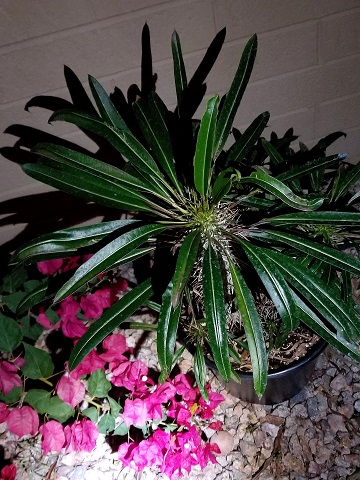
Growing in the dark


We can also breathe a little easier at night knowing that we survived another day. This is a victory. A vanquishing.


Mind as muscle. (Working out: suggestions from a non-professional.)

This is for anyone who’s decided to start working out, has started working out, and is now wondering, “How can I continue to do it?”

I’ve been asked. There’s no single answer. I can suggest, though, that one way to stay committed to working out is to stay interested in working out, and one way to stay interested in working out is to focus – not on other people, and not on yourself, but on what you’re doing.

That’s the key: In order to follow through on your commitment, you have to stay interested.


Fire in stone


1). Here’s my first suggestion:

Don’t compare yourself to others. 

Those people working out around you? Ignore them.

2). My second suggestion is the one that’s the most important to me, personally:

Focus on the fight in front of you.

Don’t focus on all the fights, all at once. Just on the one directly in front of you right now.

If you balk at the word “fight,” remember that “fight” is a common word, and that most of the time, we don’t use it in a violently combative sense.

Fight cancer, fight fatigue, fight the urge to laugh, fight the impulse to say what you’re thinking, fight for air. Fight for equality and justice and rights, if you’re so inclined. Fight for your family. Fight to defend yourself. Fight to stay alive. Fight back.

Fighting is a mental endeavor, first and foremost.

When someone says, “You have a lot of fight in you,” that’s high praise. It suggests that you’re mentally strong. You persevere. You don’t give up. You’re brave.

Imagine taking that perseverance and bravery with you when you go to work out. Imagine setting small goals to achieve your long-term goal in increments. Each small goal is a fight. Focus on it, and you may find that your interest is held because you’re immersed in a moment that has an end goal.

Fitness goals come from somewhere. They come from your mind. They come about because you’ve thought about them. You had a thought that became a decision that led to the statement “I’m going to work out.”

That’s a testament to your strength, already! You’ve declared that you’re going to work out, and it was your mind that got you over that hurdle. Your mind already did the hardest part, so you can trust it to help you follow through.

What about confidence, though?

I remove confidence from the equation because I don’t consider it to be the means to an end. I would suggest, “Just focus on what you’re doing. Don’t worry about confidence.”

After your workout, you can exult in the confidence you’ve gained knowing that you gave your ALL to that workout.

Your confidence will increase each time, developing gradually as a result of what you’re doing. Eventually, you’ll carry it with you into your workouts without even knowing it. It becomes a force that you can access subconsciously.

Going into your fitness endeavor trying to believe “I’m confident” is setting yourself up to focus on that. Your focus should be on what you’re doing, not on how you think you should be feeling.

My two suggestions are interrelated: If you compare yourself to others while you’re working out, your focus will no longer be trained on what’s in front of you. What’s in front of you is the goal you’re aiming to achieve in that moment. It’s your fight… use it to direct your focus and to keep your focus where it can benefit you the most.