Somewhere around October-November, we found out about the upcoming film American Sniper. It was set to open on Christmas day. We were looking forward to it, and I liked the idea that two years in a row, the newly released movie we’d see on my December 27 birthday would feature Bradley Cooper.
As it turned out, the movie’s release date got pushed into January, so we didn’t get to see American Sniper on my birthday. Interestingly, though, the holiday movie we did go to see on December 27, Big Eyes, also featured an actor from last year’s birthday movie: Amy Adams! We saw American Hustle (Amy Adams and Bradley Cooper) on my birthday in 2013, and Big Eyes (Amy Adams) on my birthday in 2014.
I like Bradley Cooper. It’s not a crush. I’m not obsessed with him, and I don’t race to the theatre just because he’s in a movie, but I am a fan. I’ve never seen him flounder in a role, and I’ve never seen a film of his I didn’t enjoy or appreciate in some way. Bradley Cooper in a movie usually means that I’m going to like the movie, and this is also true about Amy Adams and a few other actors (Jake Gyllanhaal comes immediately to mind); Callaghan and I are almost always on the same page, which is good. It’s more fun spending money on movie tickets if we strongly suspect that we’ll really like the movie.
So we saw Big Eyes on my birthday, and we enjoyed it, and we continued to anticipate the release of American Sniper. When the day arrived, we went to the theatre with our favorite action-flick movie-watching partner-in-crime, Jason, and I didn’t know what I was walking into. Somehow, I had the idea that the film was about a veteran who was using his lethal military skills for some grand operation in the civilian sector. I didn’t know that I was walking into a war movie. Neither did I know that the story was based on an autobiography/events that happened in the life of a real person.
And I’m glad. I’m glad that I didn’t know it was a war movie, because I generally avoid war movies. Had I known, I would have dropped American Sniper off my to-watch list, and I would have missed out on an incredible movie.
Yes, I know. I’m a Buddhist and a mostly-vegan vegetarian and I’m all about peace and compassion, but I highly appreciated American Sniper. This might seem incongruous, but it’s really not. For one thing, just on the artistic level, I thought it was a brilliant, finely-wrought film. I thought Bradley Cooper gave a tremendous, nuanced performance. I thought Clint Eastwood’s handling of the project was masterful.
Where can I even begin to try to explain my appreciation beyond that?
I guess I should start with the disclaimer that I’m not motivated by politics when it comes to art. I’m a registered Independent, anyway… my political views do tend to lean in a certain direction (if you know me well, you know what direction that is), but there’s a reason why I won’t join a particular party. Also, I generally stay away from the subject of politics on social media sites. What I’m trying to say is that I don’t intend to talk politics here today or any day. I get that it’s hard to avoid politics where this film is concerned, but I’m going to try to avoid the damn politics.
Then I should point out that I’m a combat veteran. I spent six months in Saudi Arabia, Iraq and Kuwait during Operations Desert Shield, Storm and Sabre, from the beginning of December 1990 to almost the end of May 1991. The ground war in January took all of two days, and the whole thing was rather anti-climactic after the airstrikes, but somehow I managed to get embroiled in the only real action American foot soldiers saw pushing through Iraq. I ran Commo (wire, radios) in a segment of a ground ambulance unit, and our convoy was comprised of mostly medics from my Garrison unit in Germany, along with some infantrymen, American National Guardsmen and women, and a few British soldiers. We were ambushed, and it was intense, and I brought that personal history with me going into the movie theatre to see American Sniper, not knowing, as I’d said, that it was going to be a war movie.
Now, about that Buddhist thing, since I know that it’s confusing to many people. I’ve been Buddhist all of my life, and I’ve been a martial/fighting artist for more than half of my life, and no, contrary to the popular opinion of our times, this does not create a contradiction. Buddhism and the fighting arts are not mutually exclusive. If you can understand this, then my admiration of American Sniper shouldn’t seem contradictory, either.
Rather than going into a tedious academic tangent on the principles of eastern philosophy, including the meaning of the yin-yang symbol, I’m asking that you hang with me for a minute here!
Buddhist monks in the Shaolin temple of ancient China were resourceful and inventive. They developed seitan, a popular protein-rich meat substitute made of wheat gluten, so they could avoid eating animals. They also developed Shaolin Kung Fu, a martial art that enabled them to kill with their bare hands and laid the groundwork for basically all eastern martial arts thereafter. What’s more, the full spectrum of the Shaolin martial arts system includes fighting with weapons. The “Buddhist warrior” is actually a thing, and it always has been. I’m not saying that ALL Buddhists are warriors. I’m just saying that warriors in the ranks of Buddhists have existed for ages, at least as long as there have been temples to protect. Long before Bruce Lee, there were the Shaolin Buddhist soldier monks.
Hard to believe that there’s a history of martial arts bad-assery in Buddhism, right?
Enough about me and my background. Returning to American Sniper, I want to talk about the “problem” of the veracity of (every detail of) Chris Kyle’s story. He apparently made some claims in his book that aren’t true. In my opinion, just from my perspective as a literature major, this is normal. Biography/autobiography/memoir/creative non-fiction and, loosely, historical fiction all rely on facts and factual events for the backbone of the stories within, but there’s usually good reason and/or artistic justification for alteration or invention in some places, and authors take this kind of creative liberty all the time.
Take, for example, a staple of children’s literature well-known and loved by most Americans. The Nellie Olson character in Laura Ingalls Wilder’s “Little House” series of books didn’t actually exist… she was an amalgamation of two real-life figures from her childhood. Because Laura Ingalls Wilder also altered the chronology of her family’s travels (reportedly for the sake of simplicity), she took two classmates from two of her schools in two different geographical locations and blended them together to create the one insufferable character we know as “Nellie Olson.” (The real Nellie Olson was one of the two classmates Laura Ingalls Wilder used to create the fictitious one.)
This is a well-documented fact, and yet I’ve never heard anyone say that Laura Ingalls Wilder’s stories are meaningless because she “made up” the character or “lied” about the trajectory of her family’s pioneering path, nor have I heard of anyone calling her out on any of the other half-truths, embellishments or omissions that resulted for artistic purposes. I never heard anyone say that because of all this, Laura Ingalls Wilder is not to be trusted or believed, and that the attention paid to her stories is undeserved. I never heard anyone say that the worth of other art based on the books she co-wrote about her life – namely, the world-famous Little House on the Prairie television series – was invalidated by her “lies.” I never heard anyone complain that the T.V. show was “mendacious” because Laura Ingalls Wilder changed some things, omitted things, and flat-out made other stuff up.
We know that she did these things, but we still accept her work as autobiographical. That which wasn’t real didn’t cancel out all that was real. Her story is still her story, and Chris Kyle’s story is still Chris Kyle’s story, and just because Laura Ingalls Wilder’s tone was demure and so many people dig stories about pioneer life more than they dig stories about soldiering life doesn’t mean that by majority opinion, we can have a double standard. If we’re going to call Chris Kyle a liar, then we’re going to have to call Laura Ingalls Wilder a liar for the exact same reasons, and we don’t want to do that, now, do we?
And while we’re on the subject, let’s think for a moment of how Laura Ingalls Wilder “glorified” and “romanticized” how her Pa decided to drag the family into Indian Territory and knowingly illegally squat on the Native Americans’ land, and how Laura Ingalls Wilder plainly recounted her parents’ racist attitudes and sentiments regarding the “savages” (sound familiar?) – have you ever heard anyone lambasting her for this dubious aspect of their “courageous” pioneer life? Neither have I. Needless to say, the storylines in the television series’ episodes conveniently omit any mention or reference to this part of the Ingalls’ “adventures.” Most everyone still loves the show.
But people are sure enjoying harping on Clint Eastwood and Bradley Cooper for “glorifying” and “romanticizing” the darker sides of Chris Kyle and his story.
Finally, I want to say that it’s interesting how the people shouting the loudest about how Chris Kyle was a lying psychopath (and no hero at all) are the ones who never spent a day in his or any other soldier’s boots. Now, I didn’t know Chris Kyle. I didn’t know him before, during or after his service, nor am I a psychiatrist. For all I know, he could have been a psychopath or a sociopath or whatever other -path you want to call him… but I don’t care. I don’t care if Chris Kyle was the kind of guy who’d help an old lady cross the street, or the kind of guy who’d push an old lady off a cliff. Because what I do know is that combat military training and circumstances change you in ways that civilians can’t even begin to fathom. What you were before is rendered nearly irrelevant. Even emerging from regular old Army basic training (Chris Kyle underwent Navy S.E.A.L. training, which is much more intense), you’re different than you were before you went in.
In basic training, you’re broken down from the inside out, with the whole point being to re-build you into something you probably weren’t before you went in: a killing machine that can be set into action when the circumstances call for it. The mental and physical conditioning you undergo in order to serve in combat is complete. I’m talking about the average person here. Now imagine that instead of being an average person, you were already an expert shot accustomed to taking lives (as a hunter)… and imagine, too, that your military occupational specialty is killing.
Someone’s got to do it, guys. The military is an establishment in which there’s a need for many roles, just like in civilian society, and while all soldiers are required to be conditioned in the basics, everyone has to choose an occupational specialty. Some soldiers are cooks. Others are band musicians. Others work in supply. There are the tankers, the ammo soldiers, the administration office-working soldiers, the morgue soldiers and the medics and the mechanics and the military cops and the JAG (legal) corps and the signal corps, the soldiers responsible for ensuring communications in the field (what I did – my 31K occupational title was “Combat Signaler.”) And so on, and so forth… and then you have the soldiers whose specialty is killing. These are the infantry, the “grunts.”
Regardless of your occupational specialty, though, all soldiers function the same way in combat zones, and again, to reiterate, this is what basic training is for. When thrown into a combat situation, the conditioning deep inside you surfaces, enabling you to automatically act according to the situation, and I’m sorry, but combat situations don’t usually involve making butter, choosing fabric for dresses, or embroidering. Pa Ingalls is not going to bust out his fiddle at the end of the day and make everyone laugh merrily as they sing along to his folksy songs.
When I was 18, I went to basic training and came out different than I was before, because that is what basic training is designed to do. Not only are you different, but you’re also no longer your own person. You become government property, calibrated to respond and operate on a situational basis. The minute you raise your hand and take that oath, the Constitution you’re charged to protect no longer even applies to you. You opt out of those rights in order to protect them. It’s the Unified Code of Military Justice (UCMJ) for you!
A day or two before Christmas 1990, we were out there in the vast, cold and empty Saudi Arabian desert when we were told that Sadam Hussein had threatened an attack as a “Christmas present” for the Americans lying in wait, meaning, us. We went into high alert for an indefinite period of time. I remember my 22nd birthday very well. I spent the entire day in a foxhole in the biting cold, suited up in MOPP 4 (head to toe chemical protection gear) with a full bandolier of ammo strapped around my chest and my M-16 at the ready, and again, I came out different than I was before, because that’s what happens when you spend hours on end with every cell and nerve of your being waiting to either kill or get killed. Just being in that situation day after day changes you. Even if “nothing happens,” you can’t ever be the same again.
A few weeks later, the ground war started, and we switched gear from alert to action. We convoyed out of Saudi Arabia to follow the front line through Iraq, destination Kuwait. We were a ground ambulance convoy in our Cut-V’s and Hum-V’s, and we saw and dealt with everything you’d expect to encounter on a battlefield. Then we were ambushed. There were Iraqi snipers. There were detonating landmines. There were casualties. Afterward, there were smoke grenades and medevac helicopters. I’m not going to go into the details of what I did and saw, but you can bet that again, I was a different person by the end of it.
Now, take my modest little combat experience and quadruple it and give it another hefty boost for increased severity. Chris Kyle couldn’t possibly have ended up being the same person he’d been before any of his four tours of combat duty, whatever that may have been. He killed people, as we were all prepared to do, as Navy S.E.A.L.S. were expected to do, and I would venture to guess that he saved many more people than he killed. Whether I “agreed” with the Iraq War or not, I’m grateful to Chris Kyle for his service, and for the service of all men and women in uniform in all the branches of the Armed Forces, regardless of the conflict or the reason for it or behind it, or the duration or severity of it, or the number of times they deployed, or my opinion of it or your opinion of it or anyone’s opinion of it, or anything else.
I’d like to think that if I never lived the experience of being broken down and built back up to human war-machine specs, if I never set foot in a combat zone, if I never mentally prepared to suffer and die under chemical attack or by gunfire or other ordnance, if I never swallowed 12 mysterious pills a day “in case of chemical attack”… if I never lived a day of my life serving my country… I would recognize that I’m not in a position to judge Chris Kyle.
Like him or not, Chris Kyle was a hero. As far as I’m concerned, everyone who voluntarily raises their hand and swears away their own constitutional rights in order to protect yours is a hero, whatever else they may be, and whether they go to war or not. To try to posthumously shame Chris Kyle for being the lying asshole he maybe was is to miss the point of American Sniper. Deriding Eastwood and Cooper for taking part in “glorifying” anything is also an exercise in missing the point.
Aside from all of this, what’s really important here, of course, is that we found American Sniper to be a great piece of cinematic art in and of itself. Clint Eastwood and Bradley Cooper did a damn fine job, along with everyone else who put their energies into the making of the film. I’m saying this, and I don’t even like war movies!
So, American Sniper? We recommend it. It’s not easy to watch, and I wouldn’t necessarily call it “enjoyable,” but it’s an amazing film.
On that (hopefully cheerier) note, Happy Friday, All!
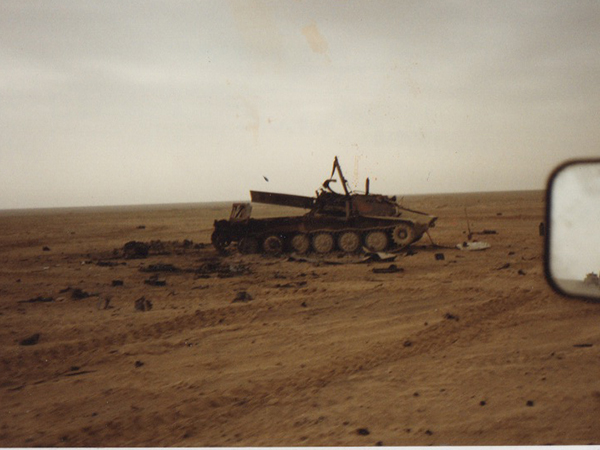
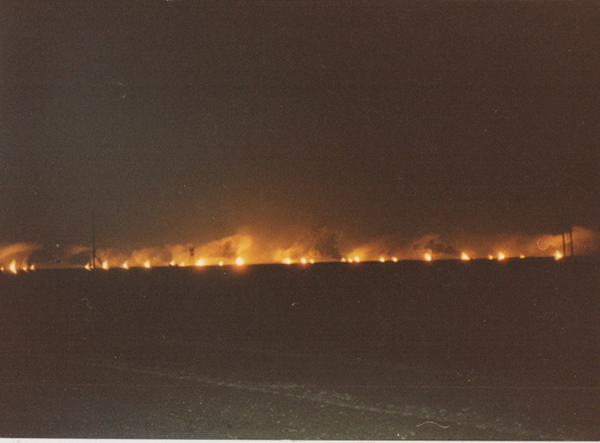
(Here are some photos I took in the war):
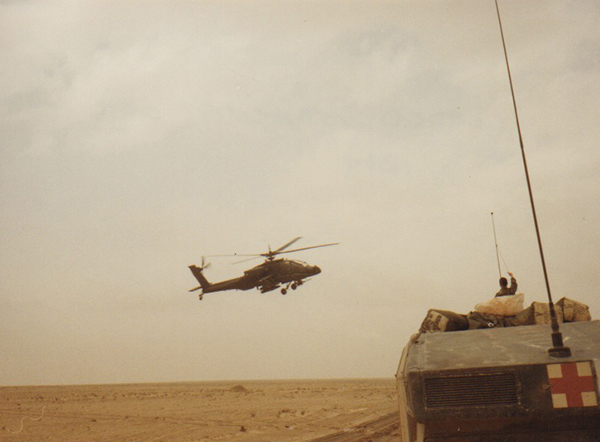
The first Hum-V ambulances….

Random tank in Iraq

After the ambush, we continued on without stopping to sleep. This is what Kuwait looked like as we approached it.
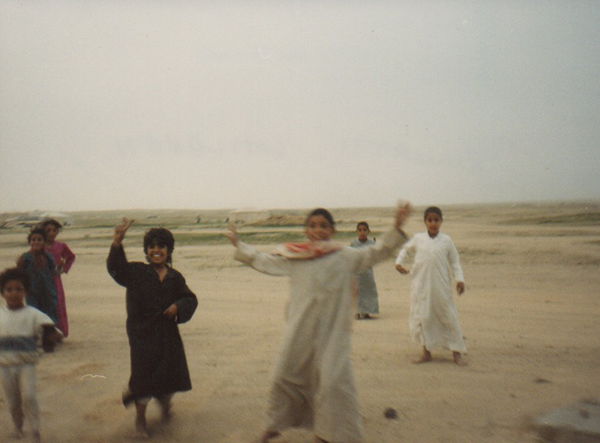
As we moved through Kuwait, children came running out from nowhere to greet us, happy and excited

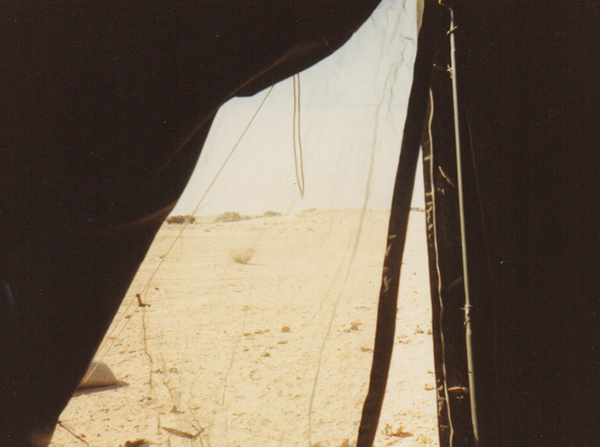
After the ground war in January 1991, this was mostly my view until we left in May.
Thanks for scanning them, Callaghan!



 That Asian-Looking Chick