
A man here on the French Riviera died recently. Men on the French Riviera die as frequently as men everywhere else, but only one was Papy, Callaghan’s grandfather.
Papy was the reason Callaghan came here to visit for two weeks last May/June. When Papy fell into medical crisis, Callaghan hurried to his side, even though it meant flying across the United States, and then across the Atlantic. Callaghan would not have thought twice about going if we lived on the moon.
Five months later, on November 2nd, Callaghan returned to France to work on a project in Normandy. In the middle of his 10-day business trip, he took a day off and flew down south to spend the day with Papy. That trip turned out to be a blessing on a deeply personal level, because within three weeks, Papy’s health declined until coma swallowed him alive, as comas do. Less than a month after Callaghan saw him that day in early November, Papy was gone.
That Callaghan and Papy had one day together recently while Papy was lucid and at home was a tremendous gift. Papy had spent a miserable summer and fall revolving in and out of the hospital for various reasons. Callaghan’s work trip couldn’t have been timed better.
When he came home, Callaghan didn’t need to describe to me Papy’s happiness during that visit. I have a warm memory of the countless times we’d trekked up the eight flights of stairs leading to Callaghan’s grandparents’ apartment: We would reach the last landing and turn the corner to find Papy and Mamie standing at the wide-open front door, waiting patiently with joyful expectation on their faces. Papy’s patience felt alive with anticipation beneath his calm exterior. That was the part about Papy and his relationship with Callaghan that I remember with the most clarity… the ritual and vision of Papy standing at the open door, waiting for his beloved grandson to appear on the landing. Every time, their faces lit up when they saw each other. There was so much love there!
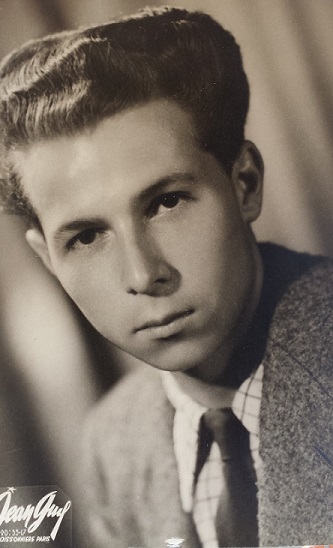
Callaghan’s Papy, c . 1950, age 25
I don’t think I’ve known anyone else as dedicated to a grandparent to the extent that Callaghan was dedicated to his Papy, despite the long distance between them after Callaghan and I moved back to the States two years ago. Their bond reached back to the 70’s, when Callaghan was five years old and his mother suffered a stroke (a shocking occurrence at her young age). Callaghan went to live with their grandparents in the wake of their Maman’s hospitalization… and throughout his teen years, Callaghan continued spending lots of time with Papy, staying at his grandparents’ place at least one night a week.
I’d always been impressed with how Callaghan so resolutely assumed responsibility for his grandfather’s health. He cared for Papy with a gravity unique to their special bond. He cared for Papy like no one else did.
Grandparents are special, especially when they take part in raising you during your formative early childhood and teen years.
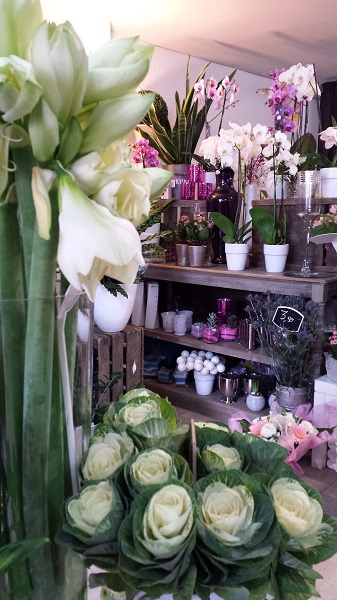
We walked to Le Jardin Secret to order the floral arrangement for Papy’s obseques (service).
I didn’t spend nearly as much time with Papy, but I got to know him through the many stories Callaghan told. How Papy played the accordion in his youth. How the events of World War II impacted him. How he’d gone on to own his own shop. How he’d enjoyed his daily walks to the center of his village, Cagnes sur Mer, to talk with his friends. How he’d loved red wine, and his Citroën Traction Avant.

Papy cherished his Citroen Traction Avant Quinze. It looked like this one.
Along with his father, Callaghan will be delivering the eulogy at tomorrow’s service, which I imagine will be difficult; writing and delivering a eulogy for the most important person in your life, for your hero, can’t be an easy thing. I’m honored that he asked me for help with writing and rehearsing it.
Such as it is that I’m here with Callaghan in France. This time, I had to join him. This is a time for family and for supporting each other. I couldn’t be with Callaghan during his earlier visits, but what matters is that I’m here with him now.
For the night of the ceremony – tomorrow night – Callaghan is planning a celebration for Papy at a favorite old pub. Everyone who will be there knew Papy, because they’re Callaghan’s long-time friends… they knew how important Papy was in Callaghan’s life, and what he meant to him.

 That Asian-Looking Chick