Right now, as I witness a number of my friends working through some pretty daunting life challenges with strength and courage, I’m inspired to muse on my default coping strategy. I prefer the word “strategy” to “mechanism” because it’s action-oriented, but the one I have in mind is actually more of a simple trick.
The idea is to navigate hardships with the cautious confidence of a surfer standing, feet planted on her surfboard, on the crest of the wave rather than flailing every which way in a murky turmoil, struggling in the lung-burning angst of one who gets pulled underwater and tossed around… right? Like everyone, I’ve spent a fair amount of time in the bewildering throes of the latter. I thought I’d relay the trick that pulls me up and out, since I’ve been thinking about it.
That is, I think about words and language a lot.
I’m talking about popular axioms in the forms of adages and idioms, proverbs and platitudes. Many of these are interchangeable, these banal sayings and feel-good, preachy expressions, and they’re clichés. They’re filler material in our lexicon, the expressions that writers are advised to avoid. If we want to write in those terms, we’re told, we can apply for jobs writing for greeting card companies or cranking out fortune cookie fortunes. We’ve developed such a knee-jerk reaction against these age-old “words of wisdom” that our eyes start to roll before we even finish hearing them, and we tend to feel insulted when someone throws one at us in the depths of our struggles. A saccharine platitude weighed down with didacticism all dressed up in a cheery tone of voice makes for a hell of a life raft, even if the people offering it have their hearts in the right place.

But I’m thinking maybe it’s different when you repeat those tired, trite expressions to yourself, because they have a way of getting me through when I’m the one using them to coach myself along. In keeping with the definition of “filler material,” the words are always right there, spilling out over the edges. The trick is to start paying attention to them, at which point you can turn them over in your head, repeatedly, performing a sort of mental twiddling of the thumbs. Then the expression takes on the function of background music, and somewhere in the repetitive space of this thinking about it without thinking about it, a sedative effect comes over you, numbing you so you can forge ahead. Dull pain is still pain, but it’s manageable, and you can work through it.
Maybe I’ve just described the power of a mantra, which would suggest that you don’t have to read tomes on Eastern philosophy, convert to Eastern religion or become a yogi to experience this effect. Ordinary Western sayings can work as mantras, too.
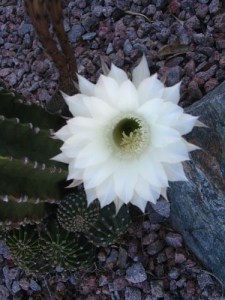
A perfect cactus bloom from my house in a past life.
It began in elementary school when I read Laura Ingalls Wilder’s On the Banks of Plum Creek and came across the adage “the darkest hour is just before dawn” for the first time. Aside from finding this to be a metaphorically beautiful expression, it just resonates in a way that other, similar sayings don’t.
Now, when the cyclical rhythm of life gears down to “Low” and I find myself spiraling off into what I call The Great Abyss of WTF for a stay of indefinite duration, that old adage comes clanging back at me like a rabid cow with tricked-out bells… yet somehow, the accompanying sound is sonorous rather than cacophonous.
“The darkest hour is just before dawn.”
Many of these expressions of age-old wisdom often ring true. It’s maddening, but expressions get overused for a reason. “Things will get better.” Circumstances in life usually do get better, but not, for some reason, before they get worse. In fact, things often have a way of getting exponentially worse just when you’re thinking that they couldn’t possibly. Right after that, though, something happens… you reach a breaking point, and then you get a consolation prize! That’s the magic. The breaking point is where the magic happens. The breaking point creates a wellspring of potential. Disaster prompts action, action leads to change, and change leads to improvement. Or, change leads to sub-sets of challenges – small steps, baby steps – that will inevitably lead to better times. “The darkest hour is just before dawn” is a potent reminder. In retrospect, I can spot the breaking points in my life and see clearly that they were just turn-around points, flashing with the lessons I needed to learn.
“Hope for the best, but expect the worst” is also helpful. For me, this proverb provides encouragement to proceed with cautious optimism and requires just a bit of old-fashioned samurai stoicism.
“This, too, shall pass” comes to mind, but this expression is more of a reassurance than a warrior cry for perseverance. It’s useful when you want to will yourself through some sort of unpleasantness. It’s what you think when you’re sitting in the dental hygienist’s chair and she’s earnestly working away with that sinister, metal tartar-scraping hook thing pierced halfway into your gum-line and she hits a nerve – zing! – every other second, and you find yourself holding your breath while your fingers curl into fists until your nails dig into your palms and sweat pops out of the pores all over your body. Breathe. This, too, shall pass. (And then it does, and then you’re fine, until the next cleaning appointment rolls around six months later.)
It’s when situations in life get tough that I brace myself for the darkening and I actually hear those words in my head, repeatedly, mantra-like: “The darkest hour is just before dawn.”
It’s true that “things could always be worse,” but this adage doesn’t inspire or motivate me in any way. It’s merely an observation, and an annoying one, at that. “Things could always be worse” is the “You don’t have the right to feel that way because that’s a FIRST WORLD PROBLEM” adage.
Yet, perspective is a profound thing, and perspective is the take-away from “things could always be worse.”
For instance, when I came back from six months in Saudi Arabia, Iraq and Kuwait during the Gulf War, I didn’t have a bad hair day for literally years, because the concept of a bad hair day is inconceivable once you’ve lived in the desert with no semblance of civilization for six months and your main concern each day is whether you’re going to live to see the next. Good/bad hair doesn’t factor into survival mode. I was able to wash my hair every once in a while out there, but it was a tedious and dicey affair (you’re vulnerable when you wash your hair!) that required using rationed water. We had small bottles of Pert (Shampoo and Conditioner in One!) that were either issued or donated… I don’t remember which, but I remember that its fresh, green scent in my hair was an unspeakable luxury once the hair-washing production was over. (I haven’t used Pert since, but I would probably recognize its scent instantly.) That’s what clean hair amounted to: an intermittent, tense luxury. 23 years later, I now certainly do have bad hair days, but I haven’t forgotten. It’s the little things, and I don’t take them for granted.
“The darkest hour is just before dawn” is my favorite adage because it does inspire and motivate me. It turns out that a lot can be done in the dark. You can do some of your best creative thinking in the dark; sight deprivation amps up your remaining senses, and with that bolstering comes an almost supernatural ability to strategize your way out of your predicament. Perhaps this is partially why some of the most compelling poets and writers in history wrote from dark places, oftentimes chronically. It’s like The Great Abyss of WTF was a grungy old motel they checked into one night and never left. (Sadly, many brilliant poets and writers died in that darkness, dissolving into addiction or turning to suicide… but they left us with a body of written work that will inspire and captivate people until the end of time.)
Another thing I do when facing extreme difficulty is I veer in the opposite direction and convince myself that the worst-case scenario will happen, and I focus on that. I plan for it. This may sound counter-intuitive, and it goes against all the variations on the “Envision your perfect situation and it will happen!” theme popularized by the self-help genre of the last 20 years. (The Secret, anyone?) But somehow, focusing on the worst rather than on the best has been a tactic that’s been of enormous benefit to me. (Here, I’m tempted to segue into the topic of Buddhism, but I’ll save that for another post.)
To focus on the worst is to put yourself in survival mode, and there, you begin to craft an action plan, since there’s nothing else to do. Once you’re in survival mode, you’re forced to take steps, many of them drastic. The alternative is to perish. That phrasing might sound dramatic, but that’s how it feels… and besides, presenting yourself with a life or death proposition works. As you funnel your energy toward that darkest imaginable place in your future, you suddenly find a). solutions to problems in unexpected places, and/or b). that while you were busy preparing for the worst, things were actually getting better… and the amelioration of your circumstances came about while you weren’t looking directly at them.
This is not as passive an approach as it sounds. The human mind naturally searches for solutions in everything, I think, even if we’re not aware of it. We take pleasure in solving mysteries and riddles and identifying patterns and finding answers. With our vision muddled, we discover other ways to make sense of things. Such as it is that things evolve… and that evolution happens in the dark.
The darkest hour is just before dawn.
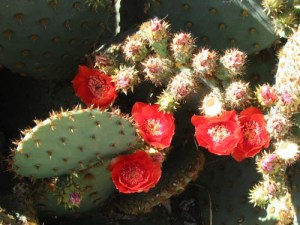
Spring in the desert is always the dawn!
What I’ve come to realize is that the darkest hours are important. The darkest hours are hard, but they’re also the pivotal, life-altering and transformative times that are essential for growth and the wisdom we need to prepare ourselves for future hardships, because there will always be future hardships. No one is exempt from the vagaries of life.
A penultimate favorite quote: “In the end, everything will be okay. If it’s not okay, it’s not the end.”
Now those are fighting words! If it’s not okay, it’s not the end.
And finally, you know what they say: “When nothing goes right, go left.”
Which is about change. It’s all about change, and progress through change. It’s revitalizing. It allows me to be the surfer standing on two feet on the crest of the wave not only with determination, but with joy, as well. There’s a sense of liberation there, and the view is stunning.


 That Asian-Looking Chick