The silver lining of a bad day is the day after.

This has been a week. I’m sure you can all relate to this: there is no day as good as the day after a really bad day. The great thing about today is that yesterday was a day of epic fuckery such that today can only be better. For one thing, I was able to get to the gym this morning. I couldn’t go on Tuesday or yesterday, so you can bet that today’s workout made an immense difference.

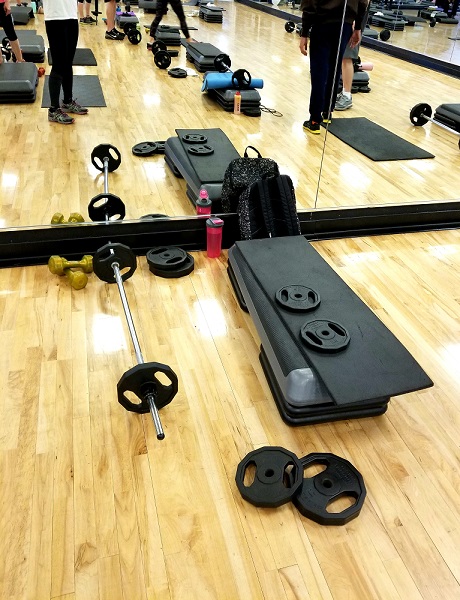
For me, everything about working out makes everything better, even an aspect as simple as setting up whatever area I use. I took this pic weeks ago when a friend pointed out how I always organize my area, with my backpack and water bottle to the left:


Organized crime.


I took this picture jokingly, but it’s soothing to see it because I see habit, and habit can be a balm. It’s a way of feeling in control; in this case, it’s a healthy way.

This post comes from a place of gratitude. Yesterday is over. Today is a new day. I have yet another doctor’s appointment this afternoon (my third this week) – one of my medical specialists – but this is a good thing. Today’s doctor will be different, and I’m very optimistic that whatever he does, the experience will be the opposite of the one I had on Tuesday. I’m talking about ophthalmology, the only medical specialty not available at our V.A., by the way.

Yesterday, man. There was just something about it. Callaghan had a Very Bad Day yesterday, too, for reasons different than mine. It was awesome that we didn’t get into it despite our equally bad moods!

I’ll try to remember to repeat this mantra on future bad days: tomorrow is a new day. Some sayings make profound sense, and there’s nothing like experience to appreciate a tired old adage as something more than a tired old adage. Everyone is different. It’s good to hone in on adages that help get us through. For me, “things can always be worse” is a good reminder, but it isn’t as reassuring as “tomorrow is a new day.”


The Fitbit and my sleep progress. (New Year’s Resolution check-in!)

We’re three months into the new year, and usually by now I’ve done some sort of New Year’s resolution check-in post, so I figured why not today.

My resolution to get more sleep has been going okay. I think what’s happening is I’m approaching it in slow steps, starting with setting up the Fitbit that Callaghan gave me over the holidays. (Christmas? Birthday? I can’t remember now, so it’s “the holidays.”) Though I’d resolved to get to bed earlier starting on January 1st, it took me until the end of January to start tracking my sleep. The first time I used the Fitbit to track my sleep (the only reason I wanted it, and the only thing I use it for) was on January 30th.

I haven’t yet made the successful jump from tracking my sleep to actually getting more sleep on a regular basis. It’s been enlightening to see my sleep schedules and patterns in digital display, though, and it gives me an idea of my natural, “before success” sleep schedule.

I set my sleep goal to 7 hrs/night, to start. (Baby steps.) The Fitbit tells you when you’ve hit your goal.

Progress: I’ve been tracking my sleep for 61 days. I hit my sleep goal 8 times out of the 61.

That’s right… I got 7 hours of sleep only 8 nights out of 61, and I know that there’s been a slight improvement. Using the Fitbit has verified that my lack of sleep situation was as bad as I’d thought it was. That’s a start, right? And that, my friends, is the whole point of the Fitbit. It’s going to hold me accountable and make it difficult for me to shrug off the effort.

Looking at the Fitbit’s “benchmark” view, I can compare my sleep to that of other women my age. I almost feel weird about sharing this, but it’s of interest to me in terms of my resolution, so here’s how I compare in terms of the minutes I spend in each of the four sleep stages:

  • Awake:* overwhelmingly less than average
  • R.E.M.: above average almost half the time
  • Light: overwhelmingly within the average range
  • Deep: above average half the time

*About the awake stage, since you may not be aware (I wasn’t, until I got the Fitbit): “It’s normal to see ‘awake’ minutes in your sleep stages; studies have shown a typical adult could wake up briefly between 10-30 times per night. You may not remember waking up since you likely fell right back to sleep, especially if you were awake for less than 2-3 minutes at a time. If you wake up in the morning feeling like you had a restless night, you may notice more ‘awake’ minutes in your sleep stages as compared to other nights.”

My “awake” minutes were much less than average. They only fell within the average range 6 out of 61 nights. Also, half of the time, I got more sleep than average in the R.E.M. and deep sleep stages. The anti-anxiety med I take before going to bed (Klonopin) knocks me out, and I stay out. It’s doing its job. (For reference: I take 0.5mg, and I weigh 115 lbs.)

I haven’t noticed that my more alert mornings correlate logically to the amount of sleep I got, or to the time I’d spent in certain sleep stages. I do notice that it’s harder for me to wake up when I’m in R.E.M. when the alarm goes off. If I’m dreaming when that alarm sounds, I’m groggy for half the day, it seems. I didn’t need the Fitbit to tell me this, though.

Now to ramp up my efforts to get to bed earlier! This is where I start setting an alarm to tell me to get ready for bed. If you see me on social media after 9:30pm, ask me why.

Wrangling with B.O.B. (Garage Gym workout!)

A minor stress-related autoimmune flare has kept me out of the gym these last two days, but the garage saved me from inactivity in the meanwhile. The ironic thing is that working out is my therapy to help reduce stress, but if stress gets to me anyway, I’m sometimes unable to do my normal workouts! I know that those of you with autoimmunity issues know exactly what I’m talking about.

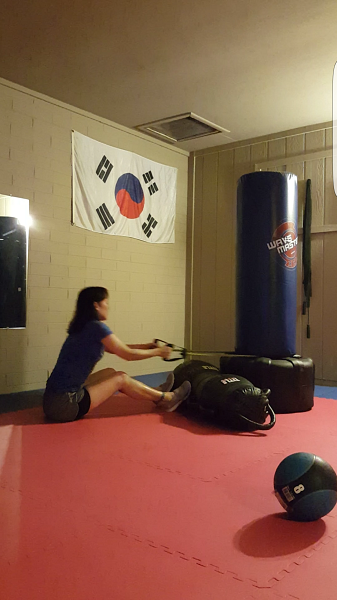
In the garage yesterday late afternoon, I wanted to challenge myself in ways that wouldn’t aggravate my right shoulder. I set B.O.B. to a greater height than usual, thinking I’d try to work with the height differential.

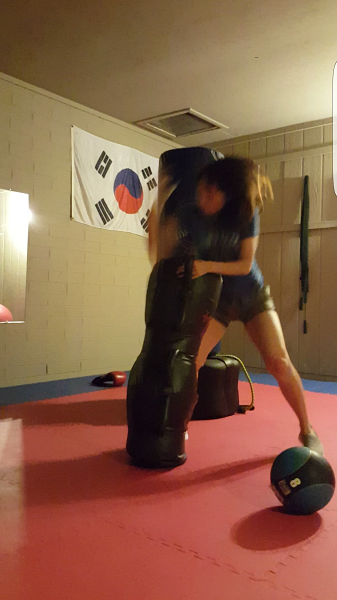
A sampling of screen shots from my workout with a 6-foot, 290 lb. dummy:


1). I started with a jump-rope cardio blast to get warm, jumping rope in 3-minute rounds to music from Disturbed’s The Sickness album.


Cardio: jumping rope


As usual, there’s nothing to see here, really. You can’t see the rope when it’s in motion.


The rope.


Moving on! Here’s the height differential I had before me:


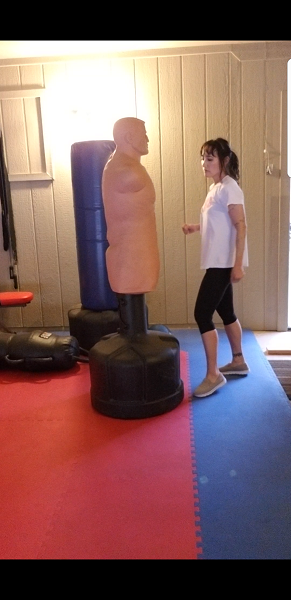
Me vs B.O.B. (height differential)


I’m 5′, 4″ and 115 lbs. In this case, B.O.B. is 6′ and 290 lbs (fully filled with water)


Me vs B.O.B. (height differential)


2). I threw some kicks to see where they’d land on someone who’s six feet tall.


Side kick (placed and held)


I have short legs and I’m not flexible, so this is as high as it’d get. This is not what would happen in reality. If you’re taller than me, I’m much more likely to blow out your knee or your family jewels.


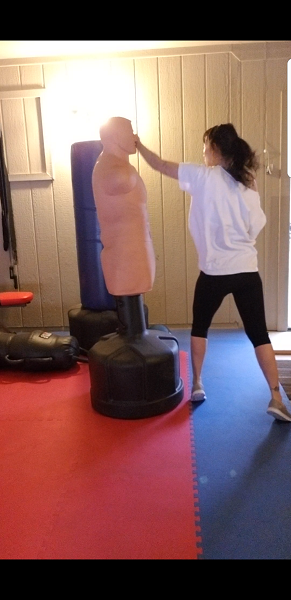
3). I tested my left back fist (leaving my right arm out of it). It was indeed a reach to get 6-foot B.O.B. in the face. In actuality, a person of this height would get throat-punched.


Back fist


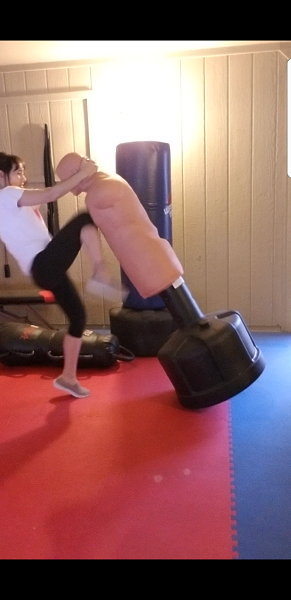
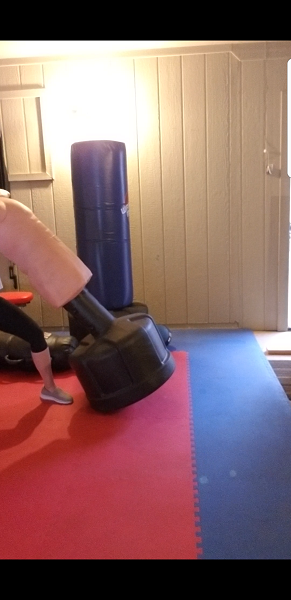
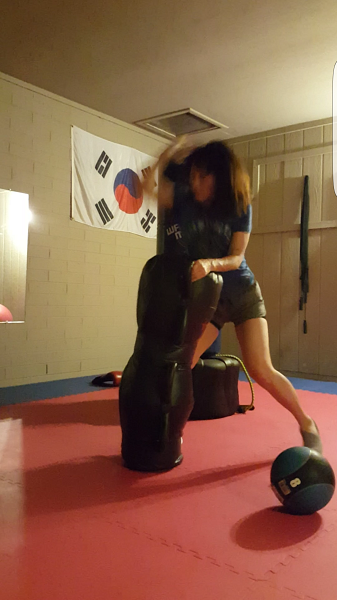
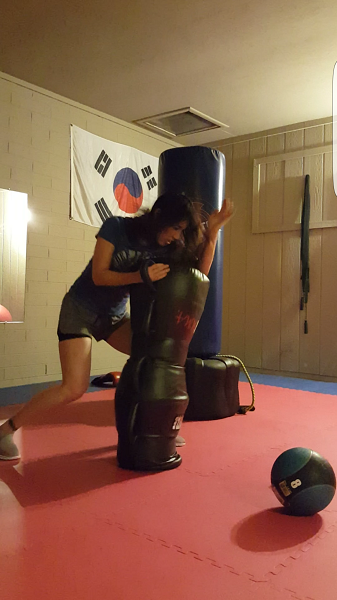
4). I tried out some knee strikes on 6-foot B.O.B.


Pulling B.O.B. down for a knee strike


Knee strike


In my current condition with my right side, I can pull all day long, but pushing overhead or straight-arm lifting/extending are a problem. I did a lot of pulling in this work-out.

For these knee strikes, I jumped in to grab B.O.B. by the base of his skull, jumped back in my stance to pull him down toward me, and then came up to land a rear knee. Unfortunately, it only got to his chest. Haha. Again, in actuality in a street situation, my knee would end up lower. That’s fine. A hard knee to your solar plexus will knock the air out of you.


5). I found out right away that a standing rear naked choke was not going to happen on 6-foot B.O.B., so I just grappled him as best as I could, really testing my strength more than anything. In real life, I’d have to get him to the ground in order to choke him.


Using B.O.B.’s base to step up and get my arm around his throat


Even stepping up, I couldn’t twist my arm around to get a proper grip, so I just did this. (My right shoulder was fine with this.)


Pulling him back by the throat from the other side (sorry we went out of frame)


This kind of wrangling with B.O.B. made for a pretty good strength-training, pulling workout (so back and biceps, I guess).

I did a little more in the way of conditioning exercises…


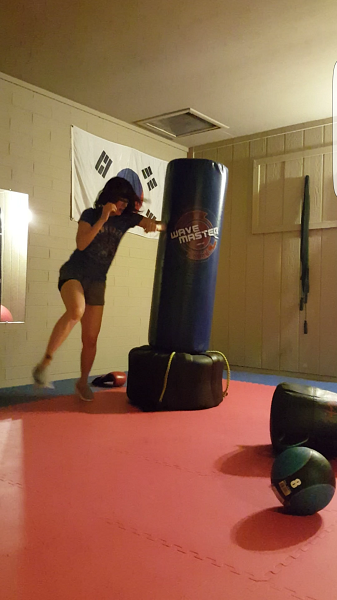
6). Speed punches for muscle endurance:


Speed punches


Again, you can’t really see anything, but there was some speed happening in these rounds of speed punches. The goal is to stand close and hit fast, not hard. This is like sprinting in place with your upper body.


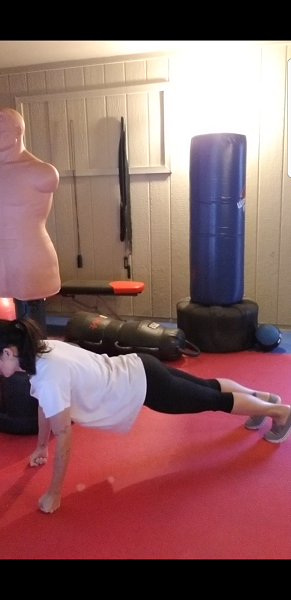
7). Jumping-in planks:


Plank


I kept a little bend in my elbows to avoid stressing my right shoulder.


Jumping in (then back out, repeat)


(I suppose all of this counts as knuckle-conditioning, too, since I’m always on my knuckles.)


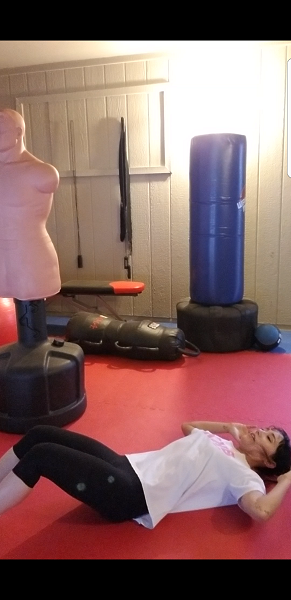
8). For abs, I just did some crunches.


Lying on the floor (doing crunches), ha


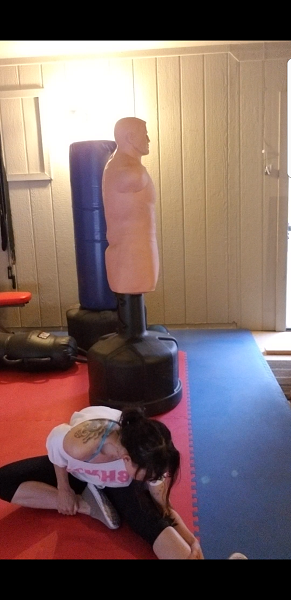
9). I finished up with some stretching.


A few stretches at the end


I forgot to take a post-workout selfie, so here’s a screen-shot of one of the times I turned to face the phone:


(you get the idea)


That was it! This was a fun garage gym session. I got to sweat a little, and the whole thing was pretty instructive, too. I’m not done working with B.O.B. set to this height.

Cancel your resolutions! (Staying motivated in the new year.)

We’re early enough in the new year that we’re still thinking and talking about our resolutions, or about our decision to not make them, as the case may be.

More than once, I’ve been asked how I keep my resolutions, so I thought I’d share my thoughts on that, for whatever they’re worth.

I’m not a life coach or a psychologist. I don’t have it all figured out. There seems to be no end in sight when it comes to my manner of inadvertently f*cking shit up or making a fool of myself or both, and the last thing I am is the walking picture of contentment, regardless of the (considerable) depth of my gratitude.

But I’m strong-willed when I have the passion to fuel my drive, and I do have a lot of that. In my opinion, that’s most of what we need. It’s hard to stick with resolutions in the absence of passion.

My main advice would be to cancel the resolution if you lose your passion for it. Focus your energy elsewhere! If the resolution is of critical importance, you will come back to it – or it will come back to you – once you’ve given yourself a break from the pressure of it. Sometimes that’s all we need to kick-start our second wind (or third, or fourth, or tenth): a break. Put that resolution down and back slowly away. Don’t hang onto it and worry over it and lament your struggle and your apathy and your “failure.” Just put it aside.

Yes, reverse psychology on your own self works.

If the resolution is not of critical importance, then you didn’t really need it, anyway. Sometimes, the mood you’re in when you make non-critical resolutions isn’t the mood you stay in for the next 365 days. That’s okay. That’s not a failure; that’s a realization.

Some other thoughts regarding staying motivated and not sabotaging yourself in sticking with your resolutions as the new year gets underway:

1). Deadlines hold no power. They really don’t. If you’re the kind of person who gets overwhelmed by the notion of a deadline, then try to relax where that’s concerned. Any progress is still progress. If all you can do today is get out of bed and get dressed, then you’ve accomplished something!

2). Don’t say too much – not to be secretive, but to keep something sacred within. There’s something weirdly empowering about hoarding a goal or an aspiration. Maybe it’s just that if no one knows you’re aiming for it, then no one can ruin it… no one can judge your progress or lack thereof. Having a resolution that only you know about turns that effort into something magical, a secret quest, a journey that you take alone. Share a resolution or two with others, but keep one for yourself. It’s amazing how progress toward your secret goal can help to build your confidence.

3). Helplessness is a mere state of mind. If you feel helpless, tell yourself that you’re not, because needing help and being helpless are two different things. Thinking “I am helpless” is self-sabotage. Thinking “I need help” is not. If you’re capable of asking for what you need, then you’re not helpless… if you need help and you have the wherewithal to ask for it, you’re not helpless. You’re more resourceful than you know, and you have more courage than you know.

4). Your journey is directed by you. You can make your own decisions, own them, learn from your mistakes, and move forward accordingly. When it’s all said and done, you have executive power over your own life.

5). Suffering is a fact of life; it’s a motivator, not an impediment.


January 2018 – Here’s to a bright and beautiful new year.


Another thing to remember: every week has a Friday, whatever day that may actually be! Again, you can decide what day that is. Revel in it.


Yawn. (New Year’s resolutions and such.)

I used to be passionate about making and keeping New Year’s resolutions. Many of you may remember that. I’m kind of blasé about it now, and maybe that’s because I have just ONE resolution for 2018, and that’s only because I’ve already resolved… to get more sleep.

Yawn. (In every sense of a word that can sum up “boring,” ho-hum double entendre intended.)

I’ve been resolving to get more sleep for a long time; 2018 isn’t the first year I’ve re-stated this. There’s only one lifestyle fix I need to make, and this is it. I know that sufficient sleep on a regular basis is essential for optimizing physical health and mental well-being. I know this. 4-6 hours per night just. isn’t. enough.

Waking up later in the morning isn’t an option. I like to be up early. The problem is that I also like to stay up late, and this is what I need to give up. I need to give up late nights. There’s no benefit to me in staying up late.

I’ll keep working on it. Honestly, I don’t know why resolutions are so difficult to keep! New Year’s resolutions, after all, are promises we make to ourselves. Why would I not do everything I can to keep a promise I make to myself? I think we set ourselves up for failure by formally setting resolutions… so I’ll end this here. I’ve said too much!!


Sleep is so exciting that only a pic of theatrical lighting and dry ice would do.


It’ll be 2018 when I post here again, so Happy New Year to you all… and good luck with your resolutions, whatever they may be!

Birthday post! (On aging.)

Not to sound like a disgruntled middle-aged person, but somehow, I’ve been dropped from AARP’s mailing list since they began their early-harassment campaign a few years ago. They were all over me when I turned – what was it, 46? – and now I’m on the eve of 49, and nothing from them. It’s FOMO more than wanting to actually sign up, I suppose.

Tomorrow is my birthday; I’ll begin my last year in my 40’s. I’ve felt sort of obligated to come up with a birthday reflection post, so I’ve been, well, reflecting.

I’m fine with aging, in general. Having to look at a downside, though, I came up with this: aging’s not fun in a typical way that aging’s not fun.

Common aging-related laments would include health complaints associated with age, “looking old” and gaining weight, failure to achieve life goals, becoming more forgetful, being broke later in life.

My only aging-related lament so far: loss.

We’re not as prepared for aging-related loss. We’re bombarded with advertisements for anti-aging products, money management firms, weight-loss programs, adult re-education programs, retirement homes. There’s a sizable market of services and shit to sell to oldsters. But there are no advertisements to help with the fact that the older we get, the more people we lose, the more beloved furbabies we bury. Maybe we get crankier and more melancholic with age because of this accumulation of loss, the general sadness that comes with watching our loved ones pass away.

Oldsters’ loneliness comes, in part, from death. It’s good to keep this in mind, to be mindful of treating the elderly with respect and compassion. They’ve seen a lot, and they’ve suffered a lot of loss along the way. Aging-related loneliness is a profound loneliness. Give oldsters a break when they’re in a bad mood or just generally negative. They may act like they don’t want us or need us, but they do, in some way or another. Love and compassion are the most invaluable commodities.

All of that being said, I’ve also found definite upsides to aging, and many of these are typical: learning from mistakes, caring less about what others think, getting closer to age-qualification for senior discounts at various places. (I needed a bit of levity there.)

Most of all, the older I get, the more gratitude I feel. I’m thankful to be alive; every birthday is a victory. I’m thankful for the people I do have in my life. I’m grateful to feel good health-wise, despite chronic illness; grateful that my body works. I feel enormous gratitude that I’m able to do what I love, and gratitude that I live in the sunniest place possible – yes, lots of sunshine matters tremendously to me and my mental well-being.

On that note, I took some selfies outside on Friday (December 22). Here’s one:


The Friday before my birthday – wearing red for the troops (2017)


I have goosebumps because there was a chill in the air, but that sun!!

Honestly, I feel like I can’t begin to stop counting my blessings. I have that many.

Clearing my mind. (Minimalism, post 6.)

In a warm comment the other day, a new subscriber (hello!)  wisely noted that “everybody’s version of minimalism is going to be different.” I loved that she wrote that. Her words inspired me and got me thinking about minimalism in a broader sense, leading me to ask myself:

What am I hanging onto in my mind that might be creating clutter? My answers:

  • The past… those negative parts of my past with nothing left to teach or offer me.
  • People… those who do not share my belief – sometimes long-held – that we’re connected in some meaningful way.

Getting at the heart of it, I’m becoming aware of the difference between decaying memories vs. thriving ones, and true, lasting personal connections vs. insincere or transient ones. Am I hanging onto rotten memories? Am I holding onto the belief that there’s a relationship where there isn’t one, or where there was never one?

Sour memories… I’ve been working to put them at rest.

Relationships that have been chimeras all along… I’ve been realizing and processing the illusory nature of them. It’s painful, somewhat, but it’s time to minimalize.

I write this without bitterness, in the spirit of realism.


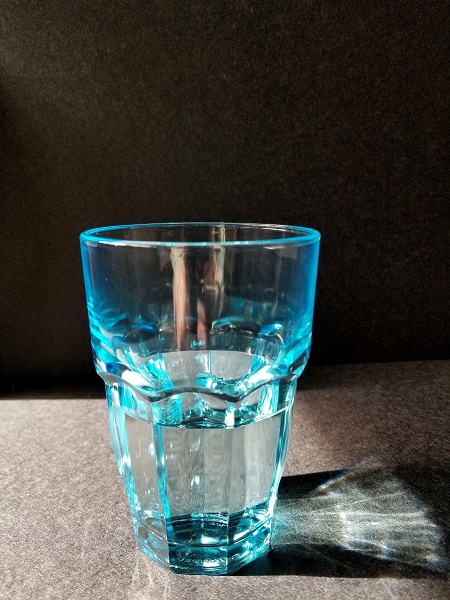
through the water glass


Decluttering my mind has become a part of my minimalism journey. Just as I need to let go of things without personal value, meaning, and purpose, I need to let go of memories without without value, meaning, and purpose. I need to learn to let go of people, too. I need to work on clearing my emotional cache.

To me, minimalism is really about that… letting go. We’ve been hanging onto things, and now we’re striving to free ourselves from those attachments. Making this endeavor in a realm beyond the physical feels just as cleansing. To clear the mind of clutter is to make more space for treasured memories and real connections.


Friday mental health meditation.

It’s been a hard week.

With chronic, clinical depression, you live with a continuous mental health ebb and flow. It’s usually unpredictable. When I feel the ebb, it’s easy to dwell on factors that might be feeding my mental state into the darkness.

Because while the low points usually come from nothing in particular (such are the vagaries of compromised brain chemistry), there are also times of stress responses to factors I can identify.

I recognize the counterproductive nature of dwelling on those factors, but still, it’s hard to avoid gnawing at them sometimes. This is why I constantly enumerate the things for which I’m grateful. When I catch myself going over the negative stuff, I can fall back on my long-standing practice of counting my blessings throughout the day, every day.

When I’m down, I try to dwell even more on the positive.

In other words, actively practicing gratitude amounts to depression damage control. I have other forms of therapy. Working out consistently is therapy, literally: exercise frees the body’s endorphins to help the brain make you feel better. Creative endeavors such as writing are therapy. Loving on (and being loved by) my cat is therapy. Eating well to avoid poisoning my body is therapy. I try to laugh a lot. I try to maintain a lifestyle that can help others, rather than hurt them. Now, minimizing my life is even a form of therapy. I see a shrink and take psych meds, as well, but in the daily course of living, it’s these other actions I choose to take that help the most.

I’m grateful to have the unwavering support of Callaghan and my parents, but I try to manage my mental health without leaning on them too much. I’d never take them for granted, but I don’t want to be needy, either. It’s helpful just knowing that they’re there. I have to take responsibility for myself, because what if they’re not there one day? I can’t allow myself to become dependent on others for my mental well-being. This is a survival instinct more than anything.

Apropos of nothing, here’s a selfie I thought would be amusing to take (the other day):


Yet another awkward mirror-selfie attempt, but hey. Hi.


There’s always another day, and next week will be a new week.


The pull toward minimalism.

Have you ever looked around at your stuff and wondered, “What if I were to get rid of it all?” I have. Since the beginning of the year, I’ve been seriously thinking about getting rid of everything.

Okay, not everything. Just a lot of things. I’ve actually been lurking around the idea of minimalism for quite a while now… for years, in fact. I’m now realizing that it’s time to do it.

I look around at things I don’t need and will never use, and I’m thinking, why is that stuff still here?

I write a post about a falling-apart article of clothing, and I’m thinking, why am I so attached to it?

Knowing, right, how ridiculous it is. For one thing, as a Buddhist, I’m fully aware that attachment to material things makes no sense at all.

I’d thought about it before, but I really started to feel the pull toward minimalism since that post about the ancient sweater I couldn’t trash. That was back in February. I wrote that post. Then I wrote the KSJO t-shirt post. Then I had to sit and examine my life choices.

I should just get rid of stuff.

Why do I develop emotional/sentimental attachment to things?

One part of my mind says “keep this” as another part says “but why.” It mostly boils down to sentimentality and “I would want this if….” But what I want more, now, is to break away from such attachments.

Three months after the sweater post, I took my first step in the minimalism direction when I overhauled my office to create as empty and blank a space as possible. Now I’m looking around wondering how I can empty the space even more. I’ve discovered that my creative energy has more freedom to flow in the absence of physical distraction.

Now it’s three months post-office-overhaul, and I’m ready for the next step. This is how I know I’m not making an impulsive decision. I tend to make big lifestyle changes slowly, in increments. (Have I ever mentioned that going vegan was a six-year process for me?)

There are degrees of minimalism, and the degree I’m going for isn’t a drastic one. I don’t aspire to a life that can fit into two suitcases, but I do plan to pare things down much as possible. I should add that I’m talking about my personal possessions, not household-type items.

Too, there are categories of things I won’t touch. At this time, anyway, I won’t even consider getting rid of books. I have books in three different rooms, on shelves, in closets, on the floor. There are hundreds of them, and they’re staying right where they are. I won’t violate my book collection with minimalism.


Books: exempt from minimalism


We’ll see how things progress from here!

I stepped on a tiny cactus and it was hilarious. (On relationship – and other – articles.)

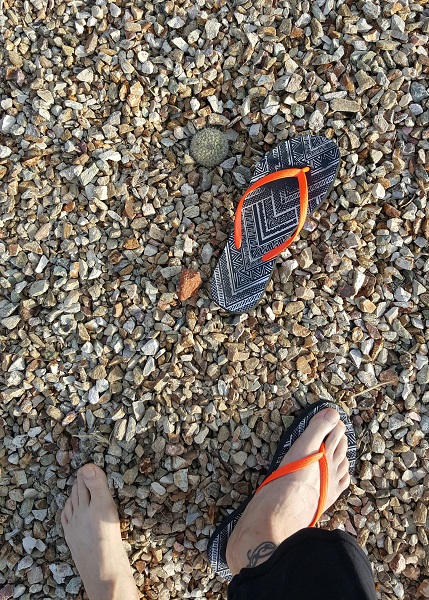
Yesterday, we were standing on the gravel in our front yard when I shifted my weight and my left foot rolled toward the outside of its flip-flop. It rolled to the left and stuck itself onto a tiny cactus.


Foot, meet (camouflaged) cactus.


The mishap wasn’t terribly painful. It was a very small cactus, as you can see at the top of the pic, and my feet are pretty dry and callused all the way around. (Apologies if this is TMI.) It was more, you know, that moment you realize that you’ve managed to roll your bare foot onto a cactus. It was more the idea of it.

There was no need for a fuss. I just exclaimed in surprise.

Me: Ah! I stepped on a cactus.

Callaghan: Poor cactus.

I thought his response was hilarious. I laughed, and I thought, he gets me. He may have been kidding, but I shared the sentiment: poor cactus! Granted, I also thought it was funny. But still… this is just us being us. Callaghan knows my sense of humor. (He also knows that my feet aren’t delicate.)

If we were a different couple, the one of us who planted the edge of their bare foot onto a cactus might’ve been miffed when the other responded with flippant sympathy for the cactus. If we read and believe the numerous “relationship” articles people are writing, we might even worry about it. Is our relationship doomed because I stepped on a cactus and he said “poor cactus”?

I’m talking about article titles such as: “10 signs that you’re headed to divorce,” “Signs that your partner might be cheating,” “What your sleep position says about your relationship,” “How to tell if your relationship is toxic to your health,” “5 things men/women hide from their partners,” “10 things he’s thinking when you’re naked,” etc.

Do you ever wonder whether these articles are written to ring alarm bells? Maybe they’re written by divorce attorneys who need clients. Maybe our divorce-rate is higher because we read such articles. I know this is hyperbole on my part. I’m just saying.

Some of the content of such articles may be universally true, but a lot of it isn’t applicable to every relationship… a person is unique, so the anatomy of a relationship is unique. How can these articles apply to everyone?

Generally speaking, I think, reading everything in the news and believing everything we read can give us doomsday ideas. Paranoia. Maybe even self-fulfilling prophesies.

On that note, I’m running late. Happy Tuesday, everyone!

Rest in Peace, Chris Cornell. (And Gen-X. And okayness.)

Man, I’m in a dark and strange mood this morning. I shouldn’t be. It’s gorgeous out there.

I live in Arizona and it’s May 19 and we’ve been sleeping with the windows open. It’s been like this for almost two weeks. The bedroom air is slightly chilly in the morning, so I reach for a light robe. This bizarre behavior can only mean one thing: we’re entering a new Ice Age.

It’s not just at night, either. After I get up, I go around the house and open one or two other windows and the front door, and leave them open for a good half-day, if not longer. I open them again in the evenings. This, my friends in other places, is paradise. We desert-dwellers love the desert, but we also love an unseasonably cool breeze through our security screen doors.

For posterity, here’s me this morning:


May 19, 2017 – in a light sweatshirt. In Arizona.


At the same time, awful things have been happening in the world, including the recent and tragic departure of Chris Cornell, whose widespread fame was launched with his Seattle grunge band Soundgarden. His death was not only shocking and sad, but also somewhat alarming for we “lost ones” of Generation X.

When you spend your childhood in the 70’s, your teens in the 80’s, and your twenties in the 90’s –and when the 90’s was your favorite decade, and Ten is one of your all-time favorite albums – the untimely deaths of icons like Kurt Cobain and Chris Cornell are sobering. It makes you want to watch Singles (older Gen-Xers), Reality Bites (younger Gen-Xers), and Office Space all day, kicked back on the couch eating chips and not looking for a job, all of us stereotypical, slovenly losers and slackers of Generation X.

Should I complete my own stereotype as a Gen-X writer and install a coffee pot on my desk?

Should I stare off into space and then write a letter? (“Dear Eddie Vedder: please don’t.”)

But I’m lucky. My depression is under control. I’m okay. We’re okay. Everything is okay. Everything is fine, despite global shenanigans at the highest levels of power, shenanigans of which there’s no need to speak. It’s like that one meme… that one where the dog is sitting in a house that’s burning down around him, and then he perks up and says, “This is fine.”

That’s a sign of our times, though, isn’t it? “Okay” and “fine” have long since been code for “things aren’t exactly hunky-dory.”  

“How are you?”

“I’m okay.”

“JUST okay?”

Commence questioning all of your life choices as you’re prompted to consider why you said just “okay.” You can’t be okay if you say you’re okay, because okay isn’t good enough. To tell the well-meaning inquirer that you’re okay is to send yourself an invitation to spill all of your not-okayness right there in the office hallway on your way to the water cooler.

Is this the product of a society defined by extremes? If we’re not flying high on the vaporous joy of life at all times, then something is wrong?

I’ll take “okay.”

Maybe this entire post was a sort of tangent. Maybe I just wanted to say, Rest in Peace, Chris Cornell.


“Be the best version of yourself.” (And other stories.)

I have a confession to make: I don’t like the phrase “Be the best version of yourself.”

The phrase has become one of my pet peeves. When I hear it, I immediately think of that Batman slapping Robin meme. You know the one.

Mind you, you don’t annoy me. I’m not judging or making fun of anyone who uses the phrase in any of its derivations. If it’s helpful to wake up in the morning and think, “Today I’m going to be the best version of myself,” then that’s awesome. It’s awesome because it works for you, and what’s more, what works for you is none of my business. Sometimes, catchy self-help adages are motivational. Whatever works!

If I may ask again, though – at the risk of sounding like a broken record – why do we insist on pressuring ourselves with all of this honing in on the self?

We’re constantly analyzing and judging ourselves, and often feeling not good enough. “Be the best version of yourself” seems counterproductive. It’s a command that could readily set us up for failure. We could end up feeling worse if, at the end of the day, we conclude that we didn’t live up to our own expectations.

Because that’s what “be the best version of yourself” means, I think: “Live up to your potential.”

“Potential” in terms of being good human beings: we don’t always have to be the hero risking our lives to save everyone all the time. It’s just as good to smile genuinely at someone to make their day a little brighter. Maybe that’s how you save someone.

“Potential” in terms of achieving excellence in everything we do: we don’t have to expect perfection of ourselves in everything we do all the time. 

Being the best version of yourself can mean that you smiled genuinely at someone, and you also made sure to not miss any spots when you cleaned the table.

Sometimes, it’s too much to try to be the best. Why even put a superlative on what “version” of yourself you’re going to be on any given day?

If you make it a personal policy to be a decent human being, there’s nothing wrong with deciding to be the flea market version of yourself, or the mix tape version of yourself, or whatever version of yourself you need to be that day… whatever version lifts your spirits. Whatever version makes your smile genuine, so you can pass it on to someone else.


Simple advice on a tank top (from my friend in France)


PHOENIX FORGOTTEN. (PTSD diagnosis story AND a review, of sorts. No spoilers.)

We went to watch Phoenix Forgotten, which brought back the year of 1997.

As I sat there, it occurred to me for the first time that the beginning of my PTSD coincided with the Phoenix Lights.

[NOTE: The link function to open the linked page in a new window is down at the moment, so you’ll have to back-arrow to get back here]

NOTE: Scroll all the way to the bottom for my very brief and informal “review” of Phoenix Forgotten.

Probably many of us living here in Phoenix metro in 1997 remember the lights that moved over the Valley in March. For me, 1997 was also eventful because it involved numerous doctors throughout the year. 1997 was the year I was diagnosed with PTSD. Yes – six years post-main event.

I wasn’t in school in 1997. I was taking a year off, the year after college and before grad school. There were only two things on my agenda for 1997: write poems and train for my black belt in Tae Kwan Do. I was also working.

So I was doing all of that, just minding my own business, like you do, and then, one night, I went to bed feeling sick to my stomach. As soon as I closed my eyes, my heart jumped in and crashed the party, like, Hey! I’m here too! Whheeeeeee! Cannonball!!!… and I couldn’t breathe, and I thought I was going to die of a cardiac event.

Then I was waking up. It was morning. What the hell just happened?

It happened again the next night, and the next and the next. It got to a point where I was too gun-shy to go bed. Going to bed had become a horrifying prospect, so every night, I put it off until I was passing-out tired. I don’t know why I didn’t go to the doctor sooner.

Eventually, I did go to the doctor, because I had an episode that was different than the others, and that was the proverbial last straw.

In that episode, I was trapped in another dimension and I was going to die for sure. Somewhere between awake and sleep, something happened. If I was completely asleep, it would’ve been a nightmare. Whatever this was, it was psychedelic and real, like, 3D real… and that was on top of the physical Armageddon that was my new normal. After I survived that night, I finally went to the doctor.

*****

1997 became a year of medical mystery. I went back and forth between different internists and specialists, cardiology and gastroenterology and cardiology again, everyone referring me to everyone else. I was deemed healthy – good news! – but I was still having these ridiculous episodes.

Then my baffled first internist started asking me questions about my background. When it came out that I was a combat vet, she referred me to a shrink. The shrink explained that panic attacks mimic heart conditions and other physical issues, which was why no one thought of the PTSD possibility.

He explained that the first episode was a panic attack. After it recurred nightly for a period of time, it became a panic disorder (PTSD, in my case). And the next-level attacks, he said, were “night terrors.”

Why did it take so long for the PTSD to manifest? He said it wasn’t unusual for vets to come home fine and then experience a trigger years later. The trigger could be anything, he said. So what was my trigger? We’ll never know, and it doesn’t matter.

All we know is that my PTSD was triggered by something in the spring of 1997. Coincidentally, I’m sure, the Phoenix Lights also happened in the spring of 1997.

*****

I sat in the movie theater remembering and pondering all of this, and that is how my non-review movie review became a post about my PTSD diagnosis.

I can’t be objective about this movie, but I can say that in my opinion, it wasn’t bad.

Phoenix Forgotten begins on a robust note, then bleeds out into the Found Footage horror movie sub-genre. In my experience, Found Footage movies made after the first Blair Witch Project are doomed to the basement where Bad Horror Flicks live. I often really enjoy Bad Horror Flicks, but I can’t even say whether this movie was bad enough to qualify as that bad.

If you’re intrigued by the Phoenix Lights and/or you’re a fan of Found Footage horror movies, you may dig this one.

Mind as muscle. (Working out: suggestions from a non-professional.)

This is for anyone who’s decided to start working out, has started working out, and is now wondering, “How can I continue to do it?”

I’ve been asked. There’s no single answer. I can suggest, though, that one way to stay committed to working out is to stay interested in working out, and one way to stay interested in working out is to focus – not on other people, and not on yourself, but on what you’re doing.

That’s the key: In order to follow through on your commitment, you have to stay interested.


Fire in stone


1). Here’s my first suggestion:

Don’t compare yourself to others. 

Those people working out around you? Ignore them.

2). My second suggestion is the one that’s the most important to me, personally:

Focus on the fight in front of you.

Don’t focus on all the fights, all at once. Just on the one directly in front of you right now.

If you balk at the word “fight,” remember that “fight” is a common word, and that most of the time, we don’t use it in a violently combative sense.

Fight cancer, fight fatigue, fight the urge to laugh, fight the impulse to say what you’re thinking, fight for air. Fight for equality and justice and rights, if you’re so inclined. Fight for your family. Fight to defend yourself. Fight to stay alive. Fight back.

Fighting is a mental endeavor, first and foremost.

When someone says, “You have a lot of fight in you,” that’s high praise. It suggests that you’re mentally strong. You persevere. You don’t give up. You’re brave.

Imagine taking that perseverance and bravery with you when you go to work out. Imagine setting small goals to achieve your long-term goal in increments. Each small goal is a fight. Focus on it, and you may find that your interest is held because you’re immersed in a moment that has an end goal.

Fitness goals come from somewhere. They come from your mind. They come about because you’ve thought about them. You had a thought that became a decision that led to the statement “I’m going to work out.”

That’s a testament to your strength, already! You’ve declared that you’re going to work out, and it was your mind that got you over that hurdle. Your mind already did the hardest part, so you can trust it to help you follow through.

What about confidence, though?

I remove confidence from the equation because I don’t consider it to be the means to an end. I would suggest, “Just focus on what you’re doing. Don’t worry about confidence.”

After your workout, you can exult in the confidence you’ve gained knowing that you gave your ALL to that workout.

Your confidence will increase each time, developing gradually as a result of what you’re doing. Eventually, you’ll carry it with you into your workouts without even knowing it. It becomes a force that you can access subconsciously.

Going into your fitness endeavor trying to believe “I’m confident” is setting yourself up to focus on that. Your focus should be on what you’re doing, not on how you think you should be feeling.

My two suggestions are interrelated: If you compare yourself to others while you’re working out, your focus will no longer be trained on what’s in front of you. What’s in front of you is the goal you’re aiming to achieve in that moment. It’s your fight… use it to direct your focus and to keep your focus where it can benefit you the most.

Muay Thai 2 (Garage gym post!)

Surprised to see another garage gym post again so soon? Well, the other day – that would be Friday – our houseguests took off in the morning, and Callaghan went back to work. I could’ve done any number of useful things, but I was feeling better after a couple of days of medical shenanigans, and the garage was just sitting there in the fine spring weather.

I had no plan, so what ended up happening was a Muay Thai workout, because that’s usually the direction I go when I wing it in the garage.

Whatever the case, I recorded my workout again. That’s just the best way for me to see where I can improve. It also allows me to share a few pics with those of you who enjoy these garage gym posts. Thank you for that, by the way!

During the 45-minute workout, I practiced the techniques in haphazard sets, mixing it up at random. Instead of jumping rope, I started with a little resistance-band rowing for a warm-up.

Speaking of which, it’s already getting warm in that garage! This year we must find a way to make it survivable during the hot months.


Let’s get this party started.


rowing (with resistance band)


rowing


(dummy migration)


lower-body warm up with a little side-shuffling (tentatively, because of my knee)


keeping warm


round chamber (warmed up and feeling okay)


round kick


(I was mindful of how I felt during this workout; I wasn’t going to continue practicing a technique if it was causing discomfort.)


teep


teep


(teep pullback)


(down elbow dummy set-up)


down elbow chamber and throw


down elbow


(same thing on the other side)


down elbow


down elbow – sticking it


back to the bag for side elbow strikes (this one’s a jump)


(That whole move right there should’ve been higher. I didn’t get in close enough, so I missed my target. I cringed when I saw the footage! I threw this strike something like 30 times throughout the workout, and it was all terrible.)


side elbow


(My ground side elbow was a little better. To be fair, though, it’s hard to get in close on a bag with a base such as this one, especially with my short reach.)


back to the dummy for knee strikes


(Left side only, since my right knee had just recovered.)

(Also, I would LOVE to have a B.O.B. again, especially for knee strikes.)


back to the bag for speed punches


(I also practiced power punches and combinations on the bag.)


to the floor for stretches (holding a modified plank – active rest)


plyo push-up (top)


plyo push-up (descending)


I finished with speed punches on the dummy, sitting on the floor and stabilizing the upright dummy between my lower legs. That was a good core workout as well as a speed and knuckle-conditioning workout…. the dummy provides a more solid punching surface than the upright bag.

Oh, there’s no “walking back” pic this time. I walked away around the edge, for some reason. But there’s a “walking on” pic at the beginning, so maybe that’ll be the new tradition. Haha.

A year later… (looking back)

Friday was the anniversary of my Major Life Change… it was a year from the day I quit my job and made a commitment to take on this writing project. I made the change on the cusp of spring (Happy Spring!), and the timing couldn’t have been more auspicious. Who doesn’t love fresh, shiny, new beginnings?

Of course we had to celebrate.

We kept it low-key, because that’s how we roll. We went for a lunch date on Friday at our favorite place near Callaghan’s work, and then for a movie date over the weekend. It was a good excuse to see John Wick 2, which I’d been wanting to see.

But I digress! Where am I a year later? I’ve been checking in with updates here and there over the last 12 months, but to recap:

Physically speaking, I’ve taken over the Room Formerly Known As Our Dining Room when the Room Formerly Known As My Office became Cita’s Room.

(“Physically speaking” is hugely important to me. I could take my laptop around the house and write, and I’ve done that and still do that, but I’m a person who needs to be grounded somewhere.)

This began innocuously enough, with just my electronics appearing on the dining room table. Things snowballed from there. I’ve even decorated the area according to my project’s theme. Writing is an art, a craft, a discipline, so if the environment needs to comply, one needs to pay attention, right?


After a year of writing, and everything that goes with it….


Some of my comfort zones have been left behind, too. Instead of having a fixed work schedule, I wake up to a unique day every day, and that’s a good thing, because it allows for fluid productivity, and fluidity is unforced. My creative energy has free reign.

I’ve recognized that for me, this kind of writing is a 24/7 job, and I’ve come to embrace that. It’s an ongoing exercise in recognizing my best hours for concentrated writing. The discipline lies in treating those times as sacred.

There’s continual reading and investigating and learning, a part of the process as a whole. For a year I’ve been eyeballs-deep in crash course after crash course on a hundred different subjects. My brain is swollen with information and (like all writers) I hope my search engine history goes unnoticed, but I haven’t felt more mentally stimulated since grad school over 15 years ago.

(The downside to this is that I’m in my head more, which doesn’t always translate to seamless social interaction. I’m flightier than ever, for one thing.)

The only concrete temporal structure I have in my week is my blog posting schedule and my gym class schedule, and that structure is non-negotiable, especially the gym part. If I don’t make it to the gym, it’s for medical or transportation reasons, or the occasional scheduling conflict.

This work has been challenging and tough from the standpoint of mental well-being, too, but it’s been positive, overall. I owe Callaghan a debt of gratitude for nudging me onto this path in the first place, and for being my number one support system and a faithful reader of the material. Also, thank you all so much for reading here and for accompanying me on this journey!

What’s in my bag?! (Apocalypse bag.)

If you’re one of my regular readers, you may have noticed that I’ve had survival on the brain these days, so it shouldn’t come as a surprise that my EDC (Everyday Carry) has evolved into a compact survival situation – I’ve been referring to my handbag as my “apocalypse bag.” I’ve only been half-joking. It’s basically a smaller version of a 72-hour bag, which is, in turn, a smaller version of a Bug-Out Bag (BOB).

There’s room left in this bag when fully packed, but it isn’t light. To solve the problem of Callaghan wanting to put stuff in my bag (thus making it heavier), I’m considering getting him a Man-Bag, Dammit (MBD), so he can carry his things around in his NutSac.

That aside, my apocalypse bag is unassuming enough. We went to Target on Monday evening, and Callaghan took this pic of me in the parking lot just to give you an idea:


Me with my EDC (aka apocalypse bag)


–See? You can’t tell that it’s holding everything AND there’s probably a kitchen sink in there somewhere, too.

–There’s an orangutan on the side because it’s a Kipling bag. I kept it there because why remove a perfectly good orangutan.

–Yes, that is my bra. No, I didn’t realize it was visible until I saw this pic. Thankfully, this top is only see-through when the camera captures me in the light of a brilliant Arizona sunset, and at this particular angle. Also because of the sunset, my black top, pants, bag, and shoes all came out in shades of orange. My hair came out red. I don’t usually filter my pics, but this was definitely a job for a filter. I went with the first one I tried (“vintage”), because in addition to kind of correcting the color, it lent a sort of noir energy to the pic, which I thought was apropos.

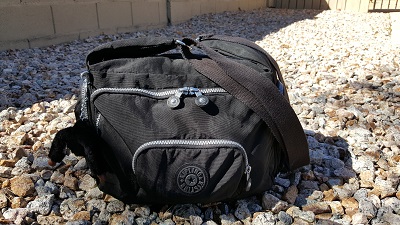
Here’s the apocalypse bag just sitting there:

Apocalypse bag, full


Here’s how I organized it:

1). Front compartment: Keys. I keep a miniature pocket knife on my key-chain, along with a bolt snap.

Apocalypse bag, front


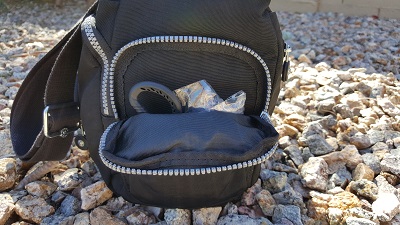
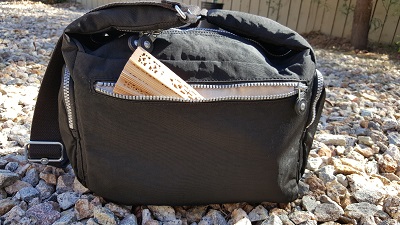
2). Side compartment 1: Kleenex, gum, glasses lens wipes.

Apocalypse bag, side


3). Side compartment 2: Earbuds.

Apocalypse bag, other side


4). Back compartment: Folding fan.

Apocalypse bag, back


5). Middle compartment: This is my main tool compartment. It holds my folding knife, which I keep attached to the sewn-in key-clasp. My knife is a Victorinox one-handed lockblade Trekker; I covered the handle in gun grip tape for a more secure grip (pro-tips). This compartment also holds my Gerber multi-tool (mainly for its pliers, wire-cutter, and wire-stripper); portable phone charger; mini scissors; mini flashlight; spare batteries for the flashlight; lighter; nail clippers; tweezers; travel adapter for electrical outlets; pen; pencil; neon post-its. With the exception of the knife, pen, pencil, and post-its, everything is packed in protective pouches and plastic zip-loc bags.

Apocalypse bag, middle


6). Main compartment, which includes an inside zip pocket that holds my passport and emergency cash stored in a zip-loc bag. (Travel-ready, though I don’t know where I think I’m going with my bag that’s full of all sorts of tools and blades and scissors and whatnot. I always have my passport on me, regardless, so it’s just a habit.)

Apocalypse bag, main compartment


See how there’s still room left in there? There’s a ridiculous amount of stuff in this compartment:

Under the top layer (normal handbag-type things), I keep four protective pouches/zip-loc bags that hold: a). disposable rubber gloves; antiviral face masks; antibacterial hand wipes; face wipes; bandanna; gallon zip-loc bag for soiled/contaminated materials (or vomit); extra Kleenex; extra lighter; extra pen and neon post-its. b). toothpaste, folding toothbrush, dental floss. c). aspirin; upset stomach tablets; ibuprofen; Emergen-C packets; antibacterial wound spray; band-aids in three different sizes. d). protein bars, fruit & nut bars, peanut butter packets.

I can also put an empty water bottle that can be filled wherever there’s water. Sometimes I have it pre-filled. A double eyeglass case for glasses and sunglasses also fits.

Here’s the empty bag:

Apocalypse bag, empty


The bag is made of water-resistant nylon. It’s very light, which is good; the only weight I’m carrying is of the stuff inside. The canvas strap is thick and adjustable for length.

That covers it, for now. This is a work in progress! I’m going to add gauze, sterile tape, and some sort of thin, strong rope. I thought of adding pepper spray in case of dog attack, but I don’t like the idea of pepper spray in my bag. I also thought of a whistle, in case of drowning emergency. (I did learn something from Titanic.)

I just like feeling ready for basic emergencies. And if the apocalypse is a zombie apocalypse, I might be able to survive that with this bag, too. (But do I need a hammer? Must research.)

The je ne sais quoi of Badassery.

A lot of people inspire me, and they’re all badasses.

Well, maybe not a lot of people. But if one badass seems like ten people, then we’re talking about a lot of people.

“Badass” is in the dictionary. Merriam-Webster says the word’s first known use was in 1955, and all of its definitions are prefaced with “often vulgar.” 60 years later, “badass” is mainstream enough that the preface isn’t warranted, in my opinion.

Badassery is tricky to define. It’s more than displaying “formidable strength or skill.” Badassery is also attitude, but to an even greater degree, another part of badassery is a je ne sais quoi that awes and renders anyone’s argument invalid.

This image is a modification of one I stole online:


thatasianlookingchick.com-Badassery


That about sums it up.

Also:

1). The fake badasses out there confuse things. It’s fake badassery (MW’s definition 1) that’s all arrogance, bravado, and swagger.

2). A fake badass can be mean, while the grit of a real badass can be mistaken for meanness. A real badass isn’t mean. (Case in point: Danny Trejo.)

3). Real badasses don’t know that they’re badasses. If they do, they don’t show it.

4). Bullies think they’re badasses, but real badasses don’t bully.

5). Confidence doesn’t always make a badass, but a real badass can beat an opponent who’s over-confident.

6). Real badassery doesn’t gloat.

7). Real badassery is when you compete with yourself, and if you defeat someone, it’s just because they got in your way.

8). If real badassery causes an accident, it doesn’t leave the scene.

9). Real badassery is lending strong authority to whatever you’re doing; your work speaks for itself. (I’m married to such a badass. Callaghan is a badass artist.)

10). Real badassery is beast-mode. It’s giving yourself 100%.

11). Real badassery is imposing your will… on yourself.

12). Real badassery is saying “f*ck you” (to bring vulgarity back into the conversation) with a game-changing action that no one saw coming.

13). Real badassery is winning because you were underestimated. (The tortoise was the badass, not the hare.)

14). Real badassery is winning because someone looked at you and mistook meekness for weakness.

15). Real badassery is looking at yourself and always seeing opportunities – and taking those opportunities – for improvement, so you never stop training, growing, learning.

16). Real badassery is getting up when you’re down and going in for more but knowing when you’ve had enough.

17). Real badassery is not quitting… it’s graciously accepting defeat, then regrouping.

18). Real badassery is focusing on the fight in front of you.

19). Real badassery is beating the odds.

20). Real badassery is surviving, then forging ahead like nothing ever happened.

We should have a National Badass Day where we take a moment to thank the badasses in our lives who inspire us to push ourselves toward our greatest potential. Everything else has its day, it seems. Yesterday was National Lemon Meringue Pie Day. Need I say more?

The Darkest Hour, Part 2

I’ve been wanting to continue on the theme of my Darkest Hour post, and I have to confess that I didn’t give it as much thought as I would have liked – but even as I finish writing this, sitting here on my lunch hour at work, I realize that it’s useless to try to compact the mysteries of nebulous life problems away into neat little lines of text. So this is just me, not being a psychologist or a counselor of any kind – there’s my disclaimer! – rambling a little about life and crises and regret and goals and action.

Mainly what I want to say is, things aren’t always as bad as they seem.

You know how when you stare at something really hard, your vision blurs until the thing becomes obscured? Or how, after searching frantically for something, you give up, only to later realize that it was sitting out in plain sight all along… it was right there, but you couldn’t find it? The answers to the biggest questions in life are often like that, I think. They’re maddeningly invisible in their obviousness.

In fact, it seems that quite often, issues arise the more we try to see, look for, search for or find things. When using variations on the sense of vision doesn’t help us to figure things out, it might be time to change strategy.

Furthermore, when searching for “what I want,” that (whatever it is) often turns out to be a mythical beast, and why waste time and energy chasing something that may not even exist? Our hearts’ desires are often illusory in the sense that sometimes, we think we know what we want, but when we get it, we realize that we want something different!

For me, the more worthwhile challenge is to open my mind to knowing what I want – more in a process of discovery, rather than a searching for. If I (at least) believe that I know what I want, I can take steps toward getting it. I can set goals and strive to make things happen. Motivated by the ambition to reach my goals, I’m exempt from the struggle to find the answer to ultimately meaningless questions like “what do I want to be when I grow up?” and the tedious preoccupation with “finding myself” that I’ve seen bog people down until they’re lost in the confusion they’ve made of their existences. I try not to overthink my life and myself.

And as much as I like to joke about it, I don’t think I actually believe in the concepts of “mid-life crisis” or “identity crisis” or “existential crisis.” There’s just crisis, and the practice of labeling it and applying definitions to it only gives us more tools of procrastination we don’t need.
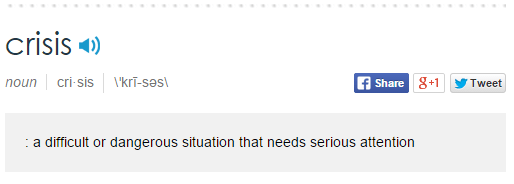
 

thatasianlookingchick.com-merriam-webster-crisis


A difficult or dangerous situation that needs serious attention.

Of course we all experience crisis, but everything can’t be a crisis. Just because we’re dissatisfied doesn’t mean that we’re “in a crisis.” There are degrees of difficulty and danger, for sure, and it’s always good to be aware (stay alert to stay alive!), but funneling our energies into taking the situation apart from the inside out usually doesn’t lead to anything but mental and emotional fatigue and frustration. We end up building apathy into the self-defeating cycle we’ve created, and that’s where we get stuck.

It’s blissfully liberating to realize that we can use that same energy to fuel our own productivity… and on our own terms.

It’s worth endeavoring to become a creator and collector of goals, both long-term and short-term. It’s worth trying to become a dedicated collector and keep those goals in sight, lined up all nice and neat.

Success, victory and triumph are personal, even intimate degrees of measure we construct for ourselves. It’s not just the day you win at a competitive event wherein everyone can witness your badassery. It’s more meaningful the day you can say, “Hey! I’ve finally stopped making that one mistake.” It doesn’t matter if you had to make that mistake five or ten or a hundred times before that. The growth still happened. You developed as a person. YOU did that for yourself, and in doing that, you gained freedom from old restraints.

Regardless of where I am at any given moment, as long as I can look back at my own life and note progress happening somewhere, in some realm of my being and existence, I feel successful.

And what of regret? I want to address this briefly, too, because it’s another thing that can drag us down.

Regret doesn’t have to be a spirit-crushing specter overshadowing our lives. Aside from the inevitable random moments of thoughtlessness in which we speak or behave carelessly (if we’re human, there’s no avoiding these moments – all we can do is learn how to handle our blunders with grace), there are difficult times during which we’re likely operating in “survival” mode, meaning that our thinking is foggy, or we aren’t thinking, at all. We’re distracted and worn-down by an onslaught of challenges that causes us to see everything as a threat. We’re propelled to action, and sometimes, in the urgency of the situation, we misdirect that action, making decisions we might later wish we hadn’t. We can make bad judgment calls regardless of the goodness of our intent. It just happens sometimes.

But it’s easy – too easy – to look back on these moments years later and feel regret, guilt or shame when we’re no longer under duress. Berating ourselves from that detached standpoint isn’t fair to our past or current selves. We can wallow in regret, or we can grow from our experiences by taking away lessons offered through them.

Regret is something we can manage by recognizing any mistakes that may have caused it and accepting that we made them, with gracious allowance for the external factors that comprise “circumstances.” Then we can gather our hard-won nuggets of wisdom and relish the satisfaction of a more mindful moving-forward. We can proceed with a purposeful energy infused with something akin to defiance and rebelliousness, that revitalizing energy that allows you to be the surfer standing on two feet at the crest of the wave not only with determination, but with joy, as well. We can commit acts of joyful courageousness on our quest to attain our goals. There’s a sense of liberation there, and the view is stunning. 

This brings me to the subject of balance, but I’ll save that for another day.