Lingering: A Ghost Story. (Non-review movie review!)

A Ghost Story isn’t a horror film, but it’s haunting nonetheless. It’s haunted my thoughts since we first saw it last week.
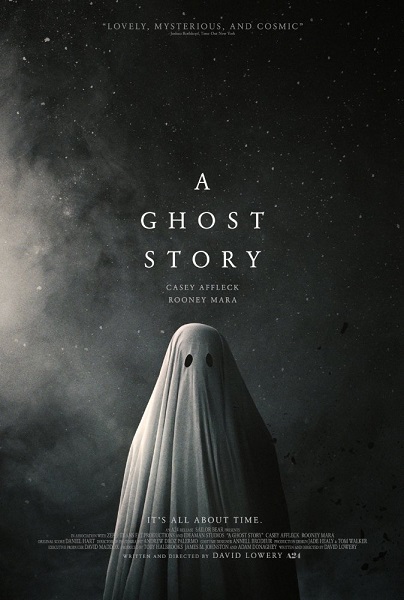


Why do some spirits choose an afterlife of haunting?

A Ghost Story  raises a multitude of questions. I might as well start with that one.

As far as haunted house movies go, I’ve never been compelled to consider the fate of the ghost, or how lonely it must be for a ghost tethered to his place of haunting. But then, I’d never seen a haunted house movie from the perspective of the ghost.

It’s a despondent ghost who’s unable to leave his place until he gets his answer, or achieves his goal, whatever that may be. Time glides endlessly and the ghost goes along with it. It’s the only dimension he can traverse.

Watching this movie was a profound cinematic experience.

We begin with a married couple, but we never learn their names. I suppose this is because the humans in their physical bodies are more or less props, there to set in motion a possibly infinite journey. In the middle of the film, another nameless person passes through to hold forth at a social gathering. The scene ends and we never see him again, but we’re left thinking.

We fall deeper into introspection. What does it mean to be alive, to exist? What does it mean to be not-alive?

We witness the pain of grieving, but we feel the ghost’s pain more than the pain of the one still living. It’s the bereft ghost whose story we follow.

A Ghost Story is a ghost’s story, yet the ghost is not the protagonist. If the film has a protagonist, it’s the place to which the ghost is fixed. Or it’s the universe. Or it’s time.

If the ghost has a voice, it’s the sheet he wears, its movement, folds, and appearance; even the shape of its eye-holes as they seem to alter with his emotion. That’s the thing about this ghost: he’s emotional, even to the point of throwing the occasional tantrum. The ghost’s sheet is his voice, and Daniel Hart’s exquisite musical score – the most sorrowful voice in the film – makes it devastating.

Thus, the driving forces of A Ghost Story are inhuman. And yet, in this inhumanity, we perceive the timeless plight of humanity. This is brilliant writing. It’s poetry.

In my humble opinion, writer and director David Lowery succeeded with his experiment in mixing mediums to tell his story. Film as poem, or poem as film? When a work of art is effectively both, it doesn’t matter how you assign its primary medium.

Speaking of mediums, I’ll touch again on the expressiveness of the ghost’s sheet, because its authority is so striking in its simplicity. I was fascinated by the way the ghost stands or sits still and turns only his head to look to the side or back, so the folds of his sheet twist with the turn. The effect is dramatic, and that is the point. Facing forward, but looking elsewhere, the ghost’s sheet conveys that he inhabits temporal realms in a transcendence of future and past. We can perceive the enormity of this by merely looking at the drape of a sheet.

A Ghost Story is a highly visual film. It’s maybe 80% silent movie, if not more so. As the ghost lingers, there’s lingering in the silence; we linger on what there is to see. There’s lingering in the sustained notes of the musical score.

There’s more I could say about the significance of music in this film, on how it helps to speak for the ghost, and why, but I’ll hold back. In this aspect, though, A Ghost Story calls to mind The Piano. In The Piano, the instrument serves as voice for Ada, who can’t speak. Also silent, Ada expresses herself through her music.

Watching A Ghost Story, tears collected in my throat early on, and they stayed there until the end, the aforementioned musical score by Daniel Hart partially responsible, I’m sure.

Callaghan was mesmerized, too. When A Ghost Story was over, we looked at each other at the same time that we both said, “I want to see it again.” And we did see it again. I would see it yet again.

A Ghost Story is a beautiful film, a story to ponder and discuss. It’s an elegant study in the philosophical discipline of metaphysics, and it’s a poem. Maybe more than a moving picture, it’s a moving poem with pictures.
 

Not Self/less Enough.

thatasianlookingchick.com-SelfLess_movie


You know how it is when you’re terminally ill and someone slips you a business card offering help, and, despite all the medical expertise your bottomless fortune could buy at the most prestigious of world-class medical facilities, you call the number, thinking that going rogue with your healthcare might resolve your mortality crisis… and if it doesn’t, you have nothing to lose, anyway?

That story.

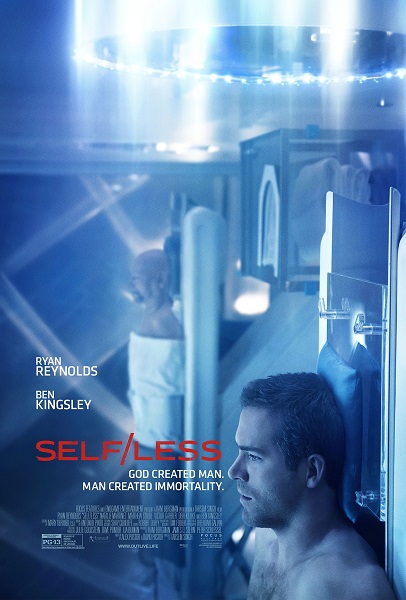
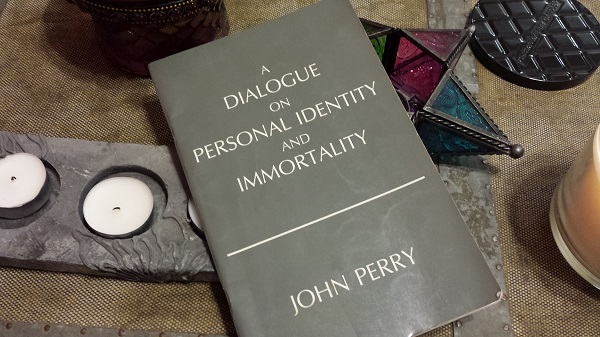
I wasn’t sure what to expect when I went with Callaghan and two friends to see the newly released sci-fi action-thriller Self/less (directed by Tarsem Singh) on Saturday, but I’d seen the trailer, and I was intrigued. Though it’s been nearly 20 years since my college metaphysics class, my copy of John Perry’s A Dialogue on Personal Identity and Immortality (1978) still occupies a sliver on my bookshelf, and it was partly because of this pamphlet-size book (required reading for the course I needed to complete my philosophy minor) that I wanted to see Self/less.


A relic from college metaphysics.

A relic from college metaphysics.


Metaphysics had been one of my favorite philosophy courses, and A Dialogue on Personal Identity and Immortality is a text that’s echoed in the ravines of my memory ever since, as personal identity theory interests me greatly. My penchant for sci-fi action-thriller-type movies would have been enough to propel me into the theater for this movie, but academic curiosity heightened my anticipation. What were the writers of Self/less going to do with this challenging metaphysical topic?

Turns out, nothing. The people behind Self/less took on the subject by not taking it on at all. This is anything but a toothsome philosophical study; about a quarter of the way through, I accepted the fact that Self/less is a dumb sci-fi action movie, romping around the casings of the ideas.

But no matter! I was really there for the fun of it and the thrill of an action-packed ride… and sometimes, truth be told, the dumber the sci-fi movie, the more I enjoy it. Before I knew just how insubstantial and mediocre Self/less was going to be, I settled back for good times, but a part of my mind remained occupied, needled by the ghostly recollection of Perry’s book. I made a mental note to pull it down from the shelf when I got home.

An hour later, the credits rolled, the lights came on, and the four of us left the theater somewhat underwhelmed by what we’d just seen. The movie fell short of delivering in the “good times” department, as well.

When I retrieved A Dialogue on Personal Identity and Immortality from my bookshelf the next day, I opened it and read the first sentence to greet my eyeballs:

“Memory is sufficient for identity and bodily identity is not necessary for it. The survivor remembered Julia’s thoughts and actions, and so was Julia.”

Just as I’d thought I’d recalled! I flipped back a few pages, read a little more, and couldn’t help but wonder if the Self/less script-writers had been inspired by Perry’s paper. The story behind the above quote reads:

“Julia North was a young woman who was run over by a streetcar while saving the life of a young child who wandered onto the tracks. The child’s mother, one Mary Frances Beaudine, had a stroke while watching the horrible scene. Julia’s healthy brain and wasted body, and Mary Frances’ healthy body and wasted brain, were transported to a hospital where a brilliant neurosurgeon, Dr. Matthews, was in residence. He had worked out a procedure for what he called a ‘body transplant’. He removed the brain from Julia’s head and placed it in Mary Frances’, splicing the nerves, and so forth, using techniques not available until quite recently. The survivor of all of this was obviously Julia, as everyone agreed – except, unfortunately, Mary Frances’ husband.” 

This, essentially, provides the premise for Self/less. The “body transplant” procedure described in A Dialogue on Personal Identity and Immortality is called “shedding” in Self/less, and Perry’s Dr. Matthews correlates to the Self/less character Albright (Matthew Goode).

In Self/less, the (cleverly named) company offering to perform the body transplant/shedding, Phoenix Biogenic, has made an exclusive private industry of the procedure, available to the 1% who could afford it. The company’s slogan? “Leaders in Consciousness Transfer Technology.”

Consciousness Transfer Technology. The door is open here for a re-con mission into the complexities of mind, consciousness and identity in relation to the body, but mostly what we get is Ryan Reynolds playing a character vacationing in another character’s body until flashes of memory from the original owner of said body clues him into the reality of his situation. A bunch of predictable shit hits the fan. “Soon I’ll be gone,” Damian (Ben Kingsley/Ryan Reynolds) intones toward the end. “I can already feel myself fading.” Our protagonist gallantly bows out after Doing the Right Thing. Imagine that!

All snark aside, I have to say that Self/less deserves points for coming up with the most elaborate suicide I can remember seeing in cinema. The movie encompasses a long, slow self-destruction from beginning to end, with Damian unwittingly employing a convoluted and roundabout method of killing himself. This path proves to be beneficial in allowing him opportunities to tie up some critical loose ends along the way, such as banging a succession of hot chicks in his borrowed body (freshly shedded Damian remarks that his new young and healthy body “has that new-body smell,” and he wastes no time in taking it out for a few joy rides) and delivering a heartfelt letter to his estranged daughter, who believes him to be dead (atonement and closure, check and check).

Self/less wasn’t the worst sci-fi action movie I’ve ever seen… I thought it was marginally better than last summer’s disappointment, Lucy… but I’m thinking it rather dulls the luster on the resumes of some of its talented actors. As Albright astutely remarks, “Immortality has some side effects.”